 |
Southern Adventure The trip north to Nova Scotia was big fun, but it was a joyful feeling to arrive back in the familiar waters of the Chesapeake Bay at the end of September. We spent a month back in our old stomping grounds enjoying the company of friends and family. It wasn’t easy adjusting to the fast pace of life on land. I drove several times from Annapolis to DC for freelance camera jobs and to visit my sister Mary. I’d forgotten about the joys of commuting in heavy traffic. The number of bad drivers out there seems to increase exponentially on a daily basis. One trip I made from northern Virginia to Annapolis in torrential rains was particularly nerve wracking. While I drove around and shot video, Kenny focused on boat repairs/upgrades and spent time with his daughter, son-in-law and grandson. Thanks again to Kai-lee (Kenny’s daughter) who put us up at her lovely home for a whole month. We had a swell time, but the sea called us, so we returned to Mary T on October 25. Not only the sea called, but some Canadians anchored in Weems Creek near our boat, woke us up with a frantic phone call telling us that another sailboat dragging anchor was drifting dangerously close to Mary T. We threw on our clothes, jumped in the dinghy and motored out to Mary T as quickly as our little inflatable would carry us. The rogue boat’s rudder was rubbing against our anchor line. We managed to avert disaster by letting out more line to get farther away. A call to the coast guard and harbormaster revealed that it was truly our problem to solve. Harbormaster doesn’t function at all before 9 a.m. and the coast guard can’t be bothered with issues that are not search and rescue or a hazard to navigation. Well, this was certainly a hazard to our navigation. We let our more line, but the unmanned boat kept drifting closer to Mary T. I was starting to get that panicky feeling where my mouth gets all dry. Since we moved aboard, our most terrifying moments have been at anchor. I always imagined high winds and waves, storms at sea to be the biggest threat. But so far, the only thing that really terrified me was dragging anchor. Anyway, we could only let out so much anchor rode before we came to the end of our tether. Then, Kenny had a brilliant idea. “Next time that boat swings away from ours, we’ll pull in our anchor rode and motor forward. That way we’ll get in front of it.” We gave it a try and it worked. Whew!! That Captain Kenny’s a sharp cookie. Shortly after that another brave boater, got in his dinghy, attached a line to the derelict boat and tied it to a Navy mooring. If he hadn’t, the drifter would’ve been a threat to all the other anchored boats. A few days later, we moved the boat to Shipwright Harbor, our old marina in Deale, Maryland. There we had a single side band (SSB) radio installed. This is very useful for getting weather reports and talking to other boaters once you leave the continental USA. At the moment all we can get out of it is squawks and moans. Great investment. 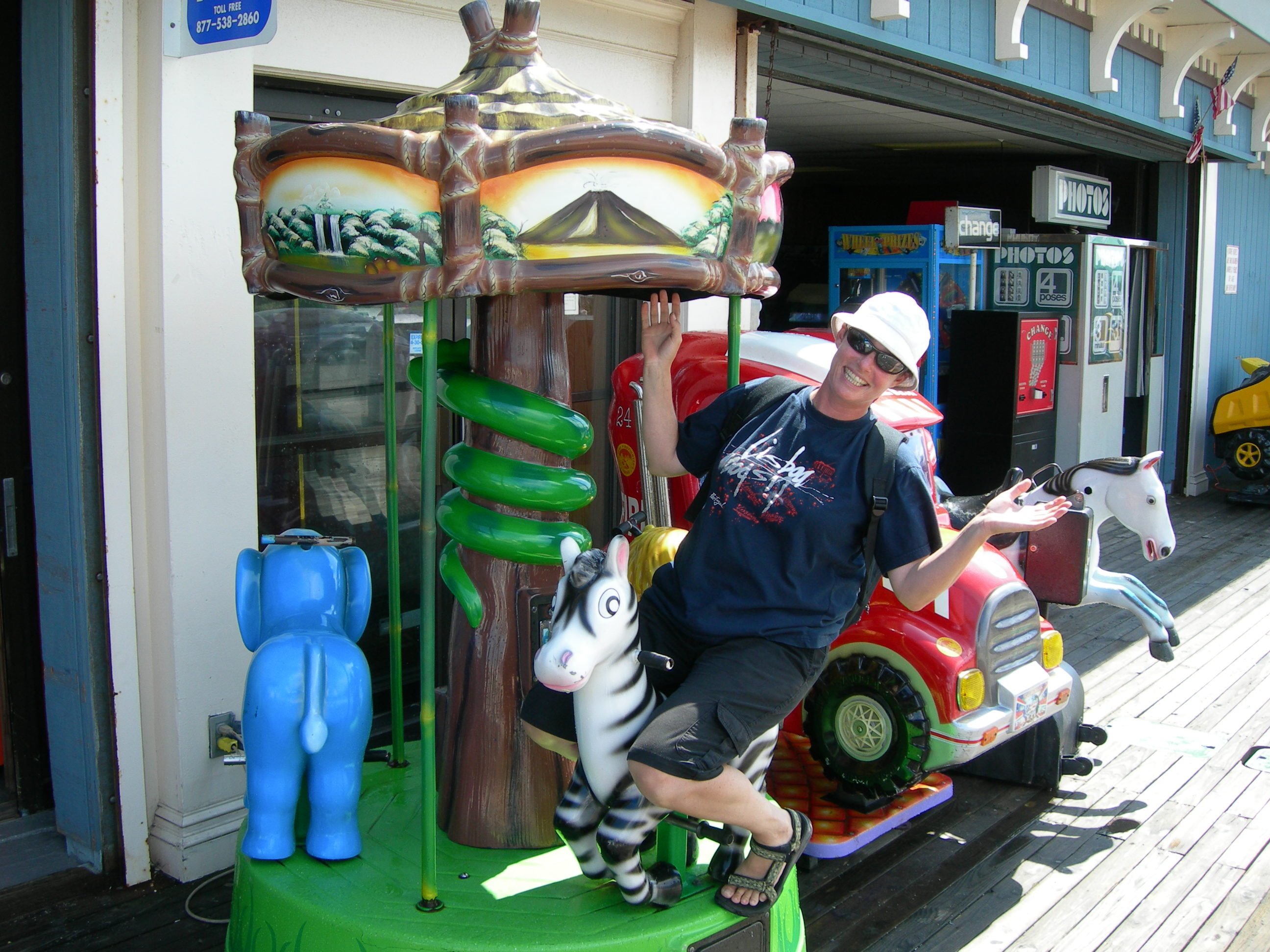 Amy enjoys a thrilling amusment ride on the Cape May boardwalk On Oct. 31, Kenny and I finally headed south joining the annual migration of snowbirds (retired boaters from North America) heading for points south via the intracoastal waterway (ICW). Like many of the other cruisers, we’re Bahamas bound. Leaving the Chesapeake Bay at the end of October makes for a chilly ride. Much to our surprise, the trip south has been far colder than the ride north. In Norfolk, on November 4, we caught up with our Canadian pirate friends, Bruce and Esther on their 43-foot Irwin, Con El Viento. It was a fairly warm, sunny evening when we dropped the hook in Wiloughby Bay surrounded by the materiel of war. Norfolk is home to the largest naval base in the world and our view included navy helicopters and warships. Bruce and Esther invited us over for dinner and we enjoyed a delicious pork roast in the lap of their luxurious center-cockpit sloop. Though only five feet longer than Mary T and two feet wider, it seems like a much grander boat. They even have an ice-maker and carry enough water to bath every day. The next morning we set off early joining the flock heading south. Leaving our anchorage in Norfolk we crossed the shipping channel in front of an aircraft carrier with helicopters buzzing around its perimeter. Glad I’m not at war with the US government. We soon learned that boating on the ICW is a bit like traveling in rush hour traffic. Instead of rushing to or from work everyone is in a mad dash south, running from the cold weather, which is already upon us. We soon found ourselves in the middle of a pack of sailboats and motor boats moving down the narrow waterway in single file. Things came to a grinding halt at our first lock. Boats were backed up for a mile and we waited at least 2 hours for our turn to enter the lock and continue forward. In the flurry to get up to the side of the lock, Kenny dropped our handheld radio overboard. Not a serious loss as it was just a back up, but Kenny was sad to see it go. As the days are short this time of year, it was doubtful we’d find a suitable anchorage before dark, so we tied up to a tree in the canal on the other side of the lock. There were about 25 other boats doing the same thing. We spent two nights there in the town of Chesapeake, Virginia exploring the strip malls and wooded environs. We hosted a dinner party on Mary T the second night with Bruce and Esther. A Thai-style peanut stir fry was the order of the day. We continued to wend our way south the following day with Bruce and Esther in the lead. More single file boating. Lots of people motor sail with their jibs out when the wind is from behind. We followed suit. We spent that night (November 8) at a marina in Coinjock, North Carolina. While Kenny washed down the boat, I went walkies with Bruce and Esther. We wended our way through a neighborhood of trailer parks, passed the American Legion, which was advertising a turkey shoot and decided to turn back when we came to a busier road that led no place. The marina had a little restaurant, so we shared a meal there. Pretty good seafood in a brightly lit, clean and mostly empty eatery. The following day, we continued our trip south. The scenery was sometimes wooded, sometimes swamp grassy, while the waterway varies from narrow channel to wide open spaces. After more single file boating, we were treated to an hour and a half of lovely sailing across the Ablemarle Sound. Lovely to turn off the motor for awhile. A couple days later we had an even livelier sail across the Pamlico and Neuse Rivers. By the time we took slips at the marina in Oriental, North Carolina it was gusting up to 35 knots. We sailed with only the jib and were averaging over six knots. I was wearing three layers of clothing on my legs, five on top, two hats and the hood of my foul weather jacket. It was chilly, but I couldn’t feel a thing. On November 11, we dropped the hook in Beaufort, North Carolina, a lovely little town on the ICW and just a stone’s throw from the Atlantic Ocean. It is full of beautiful white columned, antebellum homes and a major stopover for boaters heading north and south via the ICW and on the “outside.” “Outside” means sailing on the Atlantic, which is something we always talk about, but have yet to do since we headed south from Annapolis. It’s either been too cold or the wind is blowing in the wrong direction. We always have an excuse. Anyway, we had a lovely lunch with Bruce and Esther on the waterfront in Beaufort overlooking the anchorage. We saw some dolphins in the river, and across from us on a little island, Kenny spotted a wild horse. After eating, we walked strolled the boulevard and saw the whole downtown area in about an hour. That night Kenny and I decided we should spend another day in Beaufort to explore the island of wild ponies and see more of the town. We’d been racing south so fast, we hadn’t been able to soak up any local culture. It was time to stop and smell the roses. It was a tough decision, though, because it meant saying goodbye to our faithful companions Bruce and Esther on Con El Viento. We promised to catch up with them before their departure to Canada for Bruce’s daughter’s wedding. Our second day in Beaufort began with a trip to visit the island of wild horses. I brought my video camera and we landed our thimble-sized inflatable dinghy on the sand and tied it to a tree. No other humans were present on the island. We followed the trail of horse poops through brush and burrs and soon came to a clearing. In the distances, we spotted a small herd of the elusive wild ponies drinking from a lake. Moving quietly we crept closer for a photo op. Another horse we couldn’t see was making terrifying whinnying sounds nearby. Then I saw it dash quickly from behind some bushes and disappeared again. It seemed crazy or angry and was much too close for comfort. Frightened, I told Kenny we had to leave the island immediately. I grabbed his hand and we made for the dinghy. So much for exploring nature. We opted for a walk passed historic houses and a spooky old cemetery with live oak trees dripping with moss. After lunch, we continued walking toward a grocery store on the outskirts of town. It was more outskirty than we bargained for. Our feet grew weary so we popped into the “Oh Lord Honey Seafood” store. They said the store was another half mile or more, so we bought shrimp instead and they let Kenny use their facilities. After another discussion about sailing on the “outside” we jumped back on the ICW for more single file boating. It was really too cold to go on the outside and the wind was blowing in the wrong direction. We found ourselves among many boats we recognized. There is certain camaraderie that develops among the cruisers and people look out for one another. If there is an uncharted shallow spot or shoal in the channel, one of your acquaintances up ahead may warn you via the VHF radio. Boaters who are rude and pass slower boats without warning and without slowing down are universally despised. One day a motor boat was bouncing all the cruisers with his huge wake. We knew he was coming because everyone he passed cursed him on the radio. The following day, we heard a boater on the radio describing how the wake from this rude man’s boat caused his boat to run aground, which led to engine damage. A person is responsible for his own wake, so if the rude boater has no insurance to cover the damage he caused, he may be looking at a lawsuit. One of our favorite ICW cruisers is a guy named Jack on a cute little 29-foot trawler. His boat’s name is l’escargot. It’s a perfect name because she moves like a snail (most sailboats motor past him) and she looks like one too. Jack is always offering useful information to cruisers and helping repair boats. He’s been traveling the ICW for years and is a wealth of information. He confesses to eaves dropping on the VHF radio and monitors three channels at once. We frequently heard him on the radio saying to other power boaters, “I’ll throttle back if you give me a slow pass.” Before retiring, Jack worked in the ice fishing business on Lake Erie. Now there’s a sport I find very mysterious. The idea of sitting on a frozen lake, dangling a line into a black hole does not sound like a hell of a good time, but loads of people like to do it. Garrison Kellior believes the desire to ice fish stems from the need to get away from one’s spouse. After leaving Beaufort, North Carolina, Kenny and I spent the night anchored among many boats in the middle of Camp Le Jeune surrounded by the sounds of war. I cooked the shrimp from “Oh Lord Honey Seafood,” in a basil marinara sauce, served on pasta. We departed in the middle of the parade of boats the next day following l’escargot. Dolphins played in our bow wake and pelicans flew overhead and crashed into the water dive-bombing for breakfast. The sun was brilliant and the day a bit warmer. It felt good to be alive. That day we sailed until sunset, crossing the Cape Fear River arriving in Southport, South Carolina. We’d been planning on stopping earlier, but l’escargot kept us going. We spent a day in Southport, walking in the rain, eating our way through town. Two days later, we caught up with Bruce and Esther at marina in Bucksport, South Carolina. There was a whole contingent of Canadian cruisers there from Bruce and Esther’s marina. We’d met them briefly when we were all anchored in Annapolis. It was a grand reunion in the marina restaurant at a long table. Even the drunken dockhand joined us. He happened to mention that the only money he made was from tips, so we gave him a fist full of dollars. Later in the bar, Bruce tried to get me to dance with the dockhand, but I just wasn’t in the mood, so Esther danced with him. She’s a swell gal. The following day, Bruce and Esther flew back to Canada for the wedding of Bruce’s daughter. We hope they catch up to us upon their return. We miss them. Continuing south, we found ourselves nearly alone on the waterway. It was starting to feel warm and the scenery was beautiful – trees on both sides of the waterway; the fall colors emerging. That night, for the first time, we found a solitary anchorage. Ahhh! We’ve finally shaken the masses, we thought. In the morning we pulled up the anchor and headed back to the ICW. Twenty yards from the channel, we ran hard aground. The chart said we were in 9 feet of water. It was actually 4 feet. We tried motoring off the mud. We tried kedging. (Kedging means trying to move the boat by dropping an anchor in deeper water and hauling on the rope). We didn’t budge. We thought about waiting for high tide, but it was still going out, so it would probably be 4 to six hours before the water would be high enough to float off. Finally Kenny decided to call Boat U.S. for a tow. He’d been paying for unlimited towing service for years and we’d never used it, so it was time to give it a try. Kenny made the call. We sat and waited in our grounded boat at a 30% tilt, watching other boats pass by in the channel. Now I knew why we’d been the only ones in the anchorage. Finally, our rescuer arrived. He threw us a line that we tied to a cleat in the bow. A man of few words, he revved his engines and steered left and then right, trying to drag us out of the mud. It was a very violent process. I was afraid our cleat would get ripped off, or worse that Mary T’s keel would be damaged. The way he was weaving back and forth, I was sure he’d get our anchor line wrapped around his propeller. After 10 anxious minutes, we were finally out of the mud and back in the channel. Now we needed to get the anchor back aboard. Tow-man had said previously that he’d retrieve it for us, but now he said he had a bum shoulder and needed Kenny’s help. Kenny untied the anchor line from its cleat, tied a float to the line and threw it in the water. Now Mary T was free. The towboat pulled up alongside, Kenny jumped aboard and I continued alone down the channel slowly. I was actually single-handing Mary T. I saw the depth meter reaching dangerously low levels, but luckily I stayed out of the mud. The GPS only corresponds vaguely to the reality of the ICW, so you have to weave back and forth to find deep water. I looked back and saw Kenny trying to wrestle the anchor into the towboat. It was dug in pretty good. Then the line did get caught on the towboat’s propeller. For cryin’ out loud. I thought I’d end up driving all the way to the next anchorage alone. Kenny managed to untangle the line from the propeller and eventually brought the anchor up. The towboat pulled up alongside Mary T and Kenny jumped back aboard with the anchor. My hero! Two days later, on November 20, we arrived in Charleston, South Carolina. The weather was warm and glorious. For the first time in weeks, we wore only t-shirts. News reporter, Susie Chatham, appeared on Mary T and did her insufferable stand-up on the foredeck. We hadn’t seen her since Halifax, and thought we had given her the slip. Susie is the British reporter from the Sailing News, who’s been covering our trip. (See video clip at the bottom of the Northern Adventure). The Cooper River Marina, in North Charleston, was nice and cheap, but miles from town. Another cruising couple, Rick and Carla, generously offered us a ride into town. Bruce and Esther had told us about them, but this was our first encounter in the flesh. The four of us explored a little of Charleston together then settled into Bubba Gump Shrimp for a cocktail and appetizer. Later we found a fabulous Mediterranean restaurant for dinner. Rick and Carla were the first couple we’d met from
Montana. Not a place known for its boating, but according to them it
has one of the U.S.’s largest inland lakes. Their sailboat is a
beautiful 40-foot Cape Dory called Euphoria. Rick and Carla had run aground
several times in the ICW. Their boat draws six feet, which makes for
difficult passages in these shallow waterways. Mary T draws only
5 feet. We have met numerous boaters with engine trouble or other problems, but none of them seem in the least bit put out. They just stay put until they fix whatever needs fixing and then move along. We try to remember this whenever something goes wrong, because we’ve had relatively small problems and have truly been very lucky. Our second day in Charleston, we moved to the City Marina, which is much closer to the downtown area. We rode our collapsible bikes through the old southern streets gawking at all the gorgeous antebellum and post bellum mansions with magnificent porches. We enjoyed a lovely luncheon at a restaurant in an old house called Poogan’s Porch. Poogan was the little fluffy puppy dog that used to live there. I bet they called him “Poogie” for short. Our last day in Charleston, we celebrated Thanksgiving by taking showers and doing laundry. We like to take advantage of all the amenities a marina offers. Heading for the laundry room with a garbage bag full of dirty clothes, we eyed the mega yacht (the 99th largest privately owned boat in the world) tied up to the dock. Stepping down its gangway was a horribly hungover, young, bleached- blond, Paris Hilton type carrying a black Chihuahua in a white mink coat. I mean the dog was wearing the mink, not the tragic blond. Not even the creators of South Park could have drawn a more perfect character to emerge from that vessel. Poor little rich girl. For Thanksgiving dinner, we joined Rick and Carla at a fine restaurant for a four-course turkey dinner including sweet potato soup, salad, and pecan pie for dessert. After turkey dinner, we got back in Rick and Carla’s rental car and drove through a festival of lights on nearby James Island. It was amazing. Every local business put out a major light display. There was everything from dolphins leaping out of water, to a city block of town houses, to giant pink flamingoes. It was my first festival of lights and I can’t recommend it highly enough. December 19, 2007We could’ve spent more time exploring all Charleston had to offer with its rich history, grand old houses and live oaks dripping with Spanish moss, but the sea was calling. The day after Thanksgiving, we made our getaway. We headed for an anchorage in Steamboat Creek about 35 miles south of Charleston. The moon was nearly full so the tide was running high. The only challenging part of the day was going through Elliot’s Cut, which is a very narrow passage with strong currents. Not easy to handle the boat in such conditions, but Captain Kenny kept us out of trouble. We managed to get through it without hitting the banks or the boat in front of us. We settled into our anchorage surrounded by salt marsh and remained there for three days. The guidebooks warned against traveling the next part of the ICW during a full moon and/or northeast wind. As we were experiencing both conditions, we decided to play it safe. Apparently, these phenomena could cover up or blur the edges of the waterway, and one might be led into shallow water and get one’s keel stuck on the bottom. Grounding during an extreme high tide could leave one extremely high and dry. Many of the ICW passages in North and South Carolina are narrow waterways sculpted through vast landscapes of salt marsh. It’s sort of like driving through endless fields of wheat in the Midwest. If you’re lucky, dolphins join you and play in your bow’s wake. Our second day at the Steamboat Creek anchorage we decided to land the dinghy at a nearby boat ramp and take a walk. We headed off along a muddy, deserted road under a canopy of live oaks draped with Spanish moss. The dirt road gave way to a paved one and more houses came into view. It was an enjoyable walk until a mad dog came rushing across a lawn directly toward us. Foaming at the mouth and barking hysterically, the crazy dog stopped us in our tracks. Fortunately, he did not cross the road to attack us. We slowly turned around and headed back. The owner of the dog, whom we could not see, called Fido back. A charming man, no doubt, just like his pet. So much for a lovely walk in the country. That night, because of the strong current and opposing wind, Kenny decided we should be using two anchors instead of one. Of course, he made this decision at dusk, which in my opinion was not the best time for such a maneuver. The current was strong and it was getting dark. He thought he’d just row out in the dinghy and drop the second anchor and row back. I insisted he use the outboard motor as I did not want the current to drag him off into the salt marsh in the dark. He relented and also donned a life jacket. Safety first! The anchor deployment went off without a hitch and just to prove himself, Kenny rowed against the current all the way back to Mary T. Since then, we put out the second anchor before dark. The water was still very high when we departed Steamboat Creek, blurring the edges of the waterway, but we managed to stay in the channel and avoided running aground. We did see some shallow water on the depth finder, which always makes us nervous. Many dolphins greeted us as we approached that evening’s anchorage. The salt marsh was dotted with islands of palm trees and reminded me of Africa. The following day, more dolphins escorted us out of the anchorage and we sailed to Beaufort, SC (pronounced Byoofert) SC, another beautiful southern town with gorgeous homes and one of the oldest, continually frequented churches in the USA. On November 29, we actually sailed on the “outside” for a few miles on our way to Savannah, GA. We motored up the Bull River to stay at a marina near the home of my dear old grade school chum, DeeDee. Her real name is Dietra, but growing up together in Libertyville, Illinois, she was always DeeDee. A few years ago, she started her own business doing home makeovers and “handyman” jobs. She is truly one handy bitch and can do everything from build a screened in porch to tiling, to redesigning a bathroom. (To see comedy video of DeeDee at work, go to: www.amyflannery.com and click on “creator of comedy shorts” and then click “Makeover in Margaritaville.”) DeeDee was on the dock to greet us at the Bull River Marina. We tied up at the fuel dock and drank the obligatory, ceremonial thimble full of rum to commemorate our safe arrival in port. Looking around, we found a slip that would be easy to get out of when it was time to depart. It was about five feet shorter than our boat, but no matter. The Bull River Marina is for sale, so no one has bothered to do much upkeep as of late. The planks in the docks were getting old and everything was caked in layers of seagull poop. It didn’t matter though, as we would spend the next three nights at DeeDee’s house. In addition to DeeDee’s company, our Canadian friends, Bruce and Esther would be joining us again along with another Canadian couple Jim and Karen, on their Whitby 42 ketch, Northern Reach. After days of languishing in salt marshes, the prospect of so much socializing was thrilling. The first night in Savannah, DeeDee treated us to a lovely home-cooked meal at her place. She made her famous stuffed chicken, which was followed by a trip to the hot tub. The hot tub did us in and we flopped into bed. DeeDee pointed out that it was only 8 p.m. It was indeed a joyous occasion when we met up with our fellow sailors the following evening. Bruce and Esther hosted the cocktail party aboard Con El Viento at the Thunderbird marina on the Wilmington River. As luck would have it, a parade of lights was scheduled for that evening and we had front row seats. Boats draped in lights and some carrying giant blow-up Santas drifted slowly by the marina. We clapped and shouted and sung carols reflecting the Christmas themes the boats were displaying. “Jingle bells, jingle bells, jingle all the way. Savannah is another beautiful southern town with giant live oaks, more Spanish moss, grand old homes, and lots of pretty squares. We walked around and oooed and ahhhed. The Canadians did a guided tour by bus and learned that at one point Savanah’s biggest slave owner was a black man. Who knew? White people enjoy anecdotes like that, because it makes them feel less guilty. One of the highlights of our stay in Savannah was the cocktail party we hosted on Mary T with DeeDee and her friend Steve. Steve owns a 40-foot Morgan Out Island which he keeps at the Bull River Marina. He has a giant German Shepherd named Ben that follows him everywhere. I put on our favorite Mambo CD and we danced up a storm. Kenny was a bit under the weather, so he lay on the couch and acted as judge. I won the competition, but DeeDee felt the judging was biased. She had to admit that I had some pretty dramatic moves, though – holding the mast and dipping backwards with pointed toe toward the sky. It is always good fun getting together with DeeDee. We were hellions together in grade school and drove many a teacher close to madness with our ridiculous antics. Taking the rabbit from its cage in the science lab and walking it around on a leash was always good for a laugh. DeeDee remembers our scheme to engage an entire class to go and sharpen their pencils at the same time. It was sad to say goodbye to DeeDee but a pirate’s place is the sea, so we had to move on and get back to pillaging and plundering. We talked with the Canadians about sailing on the outside, but once again the weather conspired against us. On December 3, we bid adieu to DeeDee waving from the dock, and sailed back into the ICW to meet up with Con El Viento and Northern Reach. Before finding our friends on the water, we were hit twice with mini rainstorms that were vaguely unpleasant and somewhat blinding. We soldiered on, nevertheless. We anchored (two anchors) that night in yet another salt marsh and listened to the weather report. Things looked good for a sail on the outside, so following day we headed out St. Catherine’s Sound and enjoyed the open ocean. We sailed for a couple of hours, but the wind let up, so we were forced to crank up the old diesel and motor sail for the rest of the day. It was nice not having to worry about depths. We re-entered the ICW at St. Simon’s Sound, just north of Jekyll Island. Jekyll Island was once home to the Millionaire’s Club, which boasted members like J.P. Morgan and the Vanderbilts. Needless to say, one had to be a millionaire to join and members voted on the acceptance of new members. For some reason, Andrew Carnegie was deemed unfit to become one of the club. Arriving in the state of Florida felt like a real accomplishment. Our first stop was the town of Fernandina, which is said to have sported seven different flags over the years – Spanish, British, French, Mexican, American and I can’t imagine what the other two might have been. It was home to pirates, scallywags, and rum runners, so we felt at home there. It also has a sweet main street, lots of nice restaurants and beautiful old houses. We spent two nights there and then moved on. The flotilla broke up briefly and the Canadian boats went straight into St. Augustine, while Kenny and I chose another salt marsh anchorage just a few miles outside of the city. We wrestled with our two anchors then settled in for a cozy dinner. The following morning, on December, 8 we checked into a marina in St. Augustine, selected by Jim and Karen of Northern Reach. We all hopped on our little fold-up bikes and rode into town where we met up with Bruce and Esther who had chosen to stay in the anchorage. We decided to take a bus tour of the town to get a quick overview of the layout and history. Kenny declined opting for a coffee shop and newspaper. Despite what we all learn in elementary school about New England and Plymouth and all those pilgrims, St. Augustine is the oldest colonized town in North America. Okay, the Vikings came to Canada long before that, but they didn’t Christianize the locals, so it doesn’t count. Anyway, St. Augustine’s a grand town with lots of huge, red tile-roofed buildings, cobble stone roads and has an old-world feel to it. It is full of tourists. The bus tour allows you to get off at numerous points of interest. We hopped off at the winery and tasted some of the local vintages. They ranged from extremely dry to grape juice. They even had a sherry and a port. Doesn’t a port have to come from Porto in Portugal? That evening we were treated to yet another parade of lights on the waterfront. The riverbank was crowded with people trying to get a look, but there was little clapping and cheering. Our next stop was Daytona Beach where we anchored in rather shallow water in the company of many other boats. There were a lot of loud angry words being exchanged on one small sailboat. The man was threatening the woman with remarks like, “I’m going to break your neck,” or “I’ll take you ashore and leave you there.” These threats were peppered with plenty of expletives. At one point, they did go ashore on their dinghy with a rather large bag, so I thought he was dropping her off, but the next day we saw the two of them together again. We passed them on the ICW the next two days as their boat moves rather slowly. Each time she was wearing a huge floppy hat, which obscured her face. The Florida ICW is full of dolphins and pelicans dive bombing from great heights into the water for fish. Lots of extravagant homes dot the banks. There’s always plenty to see. Our next stop was a marina in Titusville. All our Canadian friends had booked a month there, as Esther and Bruce were flying home for the holidays. It was inexpensive and boasted a swimming pool, tennis courts, and a view of launches from Cape Canaveral. Sound too good to be true? It was. The approach to the marina was shallower than advertised so Northern Reach, which draws 5’6” bumped the bottom all the way in. We barely scooted over the top with our 5’ draft. The depth meter read 5’2” for much of the way. The only thing worse than the approach was actually arriving there. The place was a dump, and most of the boats there were badly in need of repair. Rusty spars and chipping paint were the order of the day. Large chunks of cement were falling off of the hull of a vessel docked near Mary T. Most of the live-aboards were well into the cocktail hour when we arrived at 3:30 p.m. Kenny immediately dubbed it, “the marina of lost hopes and broken dreams.” Karen, on Northern Reach, was beside herself. The idea of spending Christmas in that environment nearly brought her to tears. A brief tour of the facilities revealed a swimming pool with a crusty bottom surrounded by faded plastic furniture covered with puddles and twigs. There was a space for barbecues, which looked frequently used and unkempt. The tennis courts had large black spots with mold growing on them and planks of wood with rusty nails and old boat parts around the edges. I found the place fascinating and the people very friendly, but I wouldn’t have wanted to spend a whole month or even a week there. We witnessed the launch of a satellite or some such space junk from Cape Canaveral, just across the waterway. It looked like a tiny spark going up into the sky. Everyone stood on the docks looking up with great anticipation until it disappeared leaving only a vapor trail. I struck up a conversation with one of the toothless locals who owned a rather beat up sailboat with rusty spars. She told me her divorce had just been finalized and she was celebrating. I think she’d been enjoying the cocktail hour for sometime. We held a meeting on Mary T to choose a new marina for the Canadians. Kenny and I weren’t sure yet of our plans. After much research in several guide books and numerous phone calls, the group settled on Nettles Island Marina near Jensen Beach. It was two days journey from our current location. That evening we took two taxis to dinner at the Dixie Crossroads, which everyone recommended. It was brightly lit with fluorescent lights and the decor included giant smiling shrimp statues and neon colored coral reef sculptures. Exquisite. Three large helpings of corn fritters covered with powdered sugar were brought to the table immediately. We had to admit they were good, even though it seemed more like breakfast fare. The women all ordered shrimp and the men fish. The food was decent and the prices reasonable and the wait staff full of southern hospitality. The following morning, there was enough wind to actually sail, so Kenny and I turned off the motor for a good part of the day and sailed by jib only with the wind at our backs. We chose an anchorage just off the ICW next to a little Island near town of Palm Bay. The water was fairly warm and clean and the island looked inviting. Kenny was still feeling a bit under the weather from a lingering head cold, so he stayed aboard while I opted to visit the island with the four Canadian pirates. Bruce and Esther motored their dinghy over to Northern Reach, towed Karen and Jim on their dinghy over to Mary T in a little dinghy flotilla. I hopped aboard with Bruce and Esther. Arriving on the island, we struck up conversation with three Quebecois who sailed their two catamarans right up onto the beach and planted their anchors in the sand. One guy was alone on a huge cat that he’d built by himself over the passed three summers. The other two guys were delivering a boat to the Dominican Republic to a brother. None of them had any previous experience and they had a thousand tales of misadventure. The two traveling together had started out with four anchors and were now down to one. They lost the first anchor simply by throwing it overboard without attaching it to their vessel. We laughed and drank as the sun dipped below the horizon. When the no-see-ums came out, the Canadians built a bonfire to keep them away. As darkness fell, the sound of an air horn came from the direction of our anchored boats. We wondered if it was Kenny and looked toward the boat, but nothing seemed amiss. A few minutes later the horn sounded again. I started to think Kenny was calling us back, but it never occurred to us that he might be in trouble. It took everyone awhile to pack up and exchange e-mail addresses with the crazy French Canadians. Finally we piled back into the dinghies and headed for Mary T. By that time, Kenny was signaling us with a flashlight, so I was pretty sure there was something wrong. As we approached the boat, Kenny was at the bow and yelled that there were two people aboard our boat that had nearly drowned. He was furious that it had taken us so long to respond to his signals. I clambered aboard as quickly as possible and saw a frightened teenage couple in bathing suits, huddled together in our cockpit. “Are you okay?” Kenny wanted Bruce to take them ashore in his dinghy as it was already in the water and ours was sitting on the deck, deflated. Bruce suggested we call the coast guard instead. Kenny didn’t have much faith in that idea as we’d called the coast guard before in a non-emergency situation, and they refused to help. A boat was adrift in our anchorage, but the coast guard did not consider it a hazard to navigation and so did nothing. I understood why Bruce did not want to take them ashore. It was pitch dark; he was unfamiliar with the waters; his outboard motor sometimes quit for no reason; and he’d been drinking. I called the coast guard. They asked a million questions but the transmission was weak so I asked them to call my cell phone. The Canadians returned to their boats and I asked the young folks to come below where it was warmer. The boy was a little shaky in the legs, but he made it down the companionway. They said they had been out in their canoe without life jackets, when it sunk. They swam toward the anchored boats until they were exhausted and started crying out for help. Kenny finally saw them and encouraged them to keep swimming toward Mary T. When they were close enough, he threw them our man-overboard line, which they grabbed, and Kenny helped them aboard. The boy told Kenny he’d swallowed quite a bit of water and they were both starting to cramp up. Kenny had them sit down and brought them towels and drinking water. The coast guard finally called back and I passed the phone to Kenny who told them the story again and then passed it to the kids, so they could answer more questions. The coast guard said they would call back again. Kenny decided he’s start pumping up our dinghy in the event that the coast guard refused to help out. I offered the kids ginger ale and chocolate. That seemed to perk them up a bit. So I shot a little video and they told me their story on camera. It didn’t make a lot of sense. Don’t canoes float even when they’re upside down? We used to capsize them in summer camp and go underneath them and talk. Kenny was finished pumping up the dinghy, so I got out life jackets for everyone and gave each kid a t-shirt for warmth. I also brought a flashlight and our green and red dinghy running lights so other boats could see which direction we were headed. We all piled into the dinghy for the 1/4 mile trip to shore. Kenny and I sat on one side, the kids on the other. It’s the first time we’d put four people in the dinghy, and we fit better than I’d anticipated. We headed toward the lights on shore near where they told us their car was parked. My cell phone rang, but I didn’t bother to answer it. We slowed down as we neared the shoreline and shined the giant spotlight into the water to gauge the depth. We didn’t want to damage our outboard’s propeller by hitting bottom. Finally the boy put his leg over the side and touched bottom, so they stepped out of the dinghy into the water and handed back our life jackets. We watched the girl step ashore as the boy turned our dinghy and pushed us in the direction of our boat. I moved to the other side of the dinghy and found that the inner tube on the port side was nearly out of air and we’d left the pump back on Mary T. I thought we should stop and assess the situation, but Kenny said we’d make it back on one inner tube. I put myself on the floor in the middle of the dinghy so as not to hasten the evacuation of what little air remained in the port side tube. Kenny drove as fast as he toward Mary T’s anchor light. The trip back seemed much longer than the trip to shore, but we made it back without sinking. I climbed aboard and passed Kenny the pump for the dinghy. As he removed the stopper to put in more air, he realized that it had not been properly inserted. The string attaching the plug to the dinghy had got caught in the threads when Kenny screwed it in allowing air to leak out around the edges of the stopper. It’s the kind of thing that can easily happen when you’re trying to work fast in the dark. Fortunately, there was no hole in the inner tube. I checked my voicemail and there was a message from the fish and wildlife service calling to see if the coast guard had sent a boat to pick up the kids, because they didn’t have one. I called back and told them “never mind.” I praised Kenny for saving the lives of those children, but he couldn’t enjoy the success of his mission. He was still miffed that it took us so long to respond to his distress signals when we were on the island. I could understand that. We just couldn’t get it through our thick heads that anything could be wrong on such a beautiful evening. We drank some wine and ate leftover meatloaf and Kenny’s mood improved but I started to worry, because in our own haste to return to Mary T we never saw the boy completely exit the water and had no idea where their car really was. I wished I’d given them my phone number, so they could call and let us know when they arrived back home. Then I remembered that I’d let the girl use my cell phone to call her mother, so her number would still be in my phone. Sure enough it was, so I dialed it. What I got was the answering machine of a business, so I left a rather garbled message saying I’d appreciate a phone call regarding “your daughter’s safe arrival home.” The next day, we received a message from the girl’s stepmother saying that her daughter had indeed arrived home safely. She expressed her deepest gratitude for all we had done. Kenny is now referred to in those parts as “the savior.” On December 12 we rolled into an anchorage at Jensen Beach where Kenny’s cousin George lives. The rest of the gang settled into Nettles Island Marina just a few miles to the south. We took the trusty dinghy ashore and George was there to meet us as promised. He whisked us away in his Jaguar and took us to his lovely home in the gated community of The Landings at Sewall’s Point. Two peacocks flew from his red-tiled roof to a nearby tree when we arrived. We enjoyed a cocktail by his pool and when his wife Peggy returned from walking the dog, they treated us to dinner at a lovely restaurant nearby. Peggy is very petite and bouncy with a wicked sense of humor. Her giant poodle puppy named Brewster is always into everything, so watch where you put your glasses and hat. Everything makes a great chew toy. Peggy’s an assistant principal at a middle school. Opening hundreds of car doors for the school children every morning has given her carpel tunnel syndrome in her right wrist. George is a retired marine biology teacher. He’s very funny and a master of sarcasm, but also capable of great sincerity. I learned from George how all the Kurlychek cousins grew up in the same community and how wonderful Kenny’s mother was – always warm, jolly and laid back. On one occasion, George came to our boat to deliver some mail to us and we had a lovely chat in Kenny’s absence. George had a lot to say about Kurlychek men. Kenny’s father and George’s father ruled with iron fists. They did not encourage exploration, self-expression or risk taking. They were self-contained men who held their cards close to their chest. They expected their sons to do the right thing and if they didn’t they were threatened with a beating. Now I know why Kenny is always threatening to beat me. (NOT) George isn’t the only family Kenny has in Florida. His brother Jack lives on the west side of the state, just north of Tampa. We decided the best thing to do, would be to put the boat up at Nettles Island marina with our Canadian friends, rent a car and go pay Jack and family a visit. The drive across the state took about four hours. Jack, his wife Mary and two girls are all over six feet tall, so I felt like a midget in their midst. At about 7:30 p.m. Mary declared that she had to go grocery shopping to make dinner. I felt terrible she was going to all that trouble for us, but she said she had to go anyway. Jack made me a lovely Capirinia (fancy Brazilian drink with limes and sugar) while Mary cooked dinner. I made the salad. Kenny did about 18 loads of laundry. They are a very warm family and made me feel very much at home. Elsa, the elder of the daughters gave up her bedroom for Kenny and I. After a lovely brunch prepared by Mary, the next day, we drove back across the state to the marina. En route, we stopped at Walmart to do a massive grocery shopping. This is the fourth time we’ve shopped at a Walmart on this trip, breaking my twelve-year-long boycott of the super retailer. The boycott started when they hired Yellow Cat Productions, my former employer, to produce a video, without expressing at all clearly what they wanted. Each thing we trotted out met with their disapproval. Finally out of frustration, we abandoned the project and told them, they didn’t have to pay. Then I learned more and more about their cutthroat business practices, so I never frequented their stores. But, not working and being over budget on this trip was all it took to get me sucked back into the vortex of Walmart bargains. Boy, do they sell stuff cheap. We spent nearly $300 that day on food, wine and Christmas decorations. So today is Christmas Eve and we’re still in Nettles Island Marina. We decided to stay here for two weeks, because we needed to do a bit of work on the boat and it didn’t look like a weather window was opening to cross over to the Bahamas any time soon. The Gulf Stream, which flows from south to north lies between Florida and the Bahamas. The prevailing northerly winds kick up large waves and make crossing dangerous. It is necessary to wait for a southerly or westerly wind to make the 50 nautical mile crossing. During the winter months, these weather windows are rare. We’ve been enjoying Nettles Island Marina quite a bit. It’s nice to just stay put for a while. Many of the snowbirds parked here come every year and spend the whole winter. It’s a very convivial atmosphere. There’s the “Cranky Conch Boat Club Tiki Hut for Boaters Only” where people hang out at all hours chatting and sharing sea stories. It’s particularly lively at the cocktail hour. One evening a couple from Maine threw a lovely Christmas party with lots of great hors d’oeuvres and plenty of drink. We were told NOT to bring a thing. The only drawback here is the no-see-ums, which are vicious the moment the sun goes down. I am covered from head to toe with bites. We now shower before sunset and put on long pants, long sleeved shirts, socks and hats. Closing up the boat, turning on the fans, and using minimal lighting keeps their numbers down. I have questioned lots of people here about different possible routes to cross the Gulf Stream. Everyone has a different opinion. I guess we’ll just have to make up our own mind. We’ll either cross from Lake Worth or Fort Lauderdale to West End, Grand Bahama; or from Miami to Bimini. We’ll probably visit the southern islands first and then work our way north hitting the northern ones (Abacos) in the spring. Nettles Island is an unusual little place. It’s packed full of trailer homes with the odd brick and mortar home thrown in. It is lick-the-pavement clean and orderly and most of the people drive golf carts to get around. It is a gated community, so each time we leave by car we have to get a pass to come back in. The relationship with the marina is apparently strained and we are not supposed to wander around the island. We’re only allowed to go in the direction of the beach, which is off of the island. The other day when Kenny was walking back from the beach, the guard in the glass booth asked if he had a walking pass. Kenny thought it was a joke at first, but it’s for real. No one has asked me for one, yet. We spend our days doing boat repairs, shopping, biking, jogging and lounging on the beach with Jim and Karen. Kenny does most of the work, and I’m in charge of leisure activities and meals. We share many meals with Jim and Karen. They have a lovely boat and a large cat, who’s a bit unpredictable. They have a rental car and are very generous about taking us with them to go shopping and explore different beaches. Bruce and Esther went back to Canada to enjoy the holidays with their families. Last night, after dinner on Northern Reach, we all walked to the beach to look at the surf in the moonlight. Beautiful. I sung Christmas Carols the whole way with scant participation from the others. We’re working on a nautical version of the 12 Days of Christmas. Cousin George and Peggy invited us to spend Christmas day at their home. In the evening, we’ll return to the marina and hang out with Karen and Jim on Northern Reach. I will miss spending Christmas with my dear family and all the merriment and singing of carols. Mother and I always enjoy holding down the melody in our beautiful soprano voices, while sisters create inventive harmonies. Today is Christmas Eve. We’ve done our best to create a festive ambiance aboard Mary T. We have a string of lights outside and a tiny tree inside decorated with my jewelry and seashells. Cheap ornaments purchased in Fernandina and Savannah hang from the knobs on the port holes. Merry Christmas everyone! May the virgin birth of the little baby Jesus warm the cockles of your heart. January 5, 2008On Christmas day I arose around 8 a.m. and filled Kenny’s tiny stocking (four inches tall) with candy from the convenience store. I then set to baking a giant cow pie cookie to bring to the brunch in the Tiki Hut at 11 a.m. Kenny had purchased chocolate chips a month ago with the idea of making cookies, so we still had all the ingredients. I decided to make a sort of pan cookie/brownie with it. No time for little individual cookies. When I was pouring the light brown raw dough into a round baking pan it reminded me of a cow pie, thus the name. Kenny and I drank mimosas and opened our presents all of which had been purchased at the Sand Dollar Casual Apparel store right next to the marina. I got Kenny a pair of shorts and he got me a light weight v-neck sweater and flowery shorts that I had picked out and put on hold. He also surprised me with a silver dolphin necklace. In our excitement over the present opening ceremony I forgot about the cow pie pan cookie in the oven, so it was a little burnt on the bottom and around the edges. I was crestfallen, but it was the only thing we had to bring to the brunch, so I cut it up into little squares and brought it over to the Tiki Hut. Kenny picked up a bottle of champagne as well. The usual gang from the marina was over at the brunch and there was tons of food including breakfast casseroles, sticky buns, smoked salmon, waffles, fruit salad. It was all very good. People were asking if my breakfast squares were pumpkin or gingerbread. “They’re cow pie.” I did not eat a great deal at the brunch, because Kenny’s cousin George was going to fetch us and bring us to his house for another meal with his wife, Peggy, and mother-in-law. We returned to the boat to fetch all our laundry to bring over to George and Peggy’s and waited in the parking lot. At 1 p.m. George appeared and we hopped in his roadster and sped off to his house. Peggy’s mother is 85 and a very together, sweet lady. Her late husband was a Freudian psychologist and his brother studied with Anna Freud. We sat around for a few minutes chewing the fat, then Peggy took me fruit picking in the back yard. She gathered several grapefruit for us and then asked her Italian neighbors Archie and Gina if we could come over and grab some lemons from their trees. “Of course. And bring your motha’ ova’. I got some cookies for her.” We called Peggy’s mother over and sat in Gina’s kitchen. All the décor in the kitchen, living room and dining room was pink and white with plenty of rococo flourishes and knickknacks. Gina gave us a tour of her Christmas tree collection. There were three, including one small one on the bathroom counter each with its own color scheme and perfectly placed, color coordinated ornaments. She handed over a huge plate of cookies to Peggy’s mother and explained how she’d been baking for days. “Here take these. I don’t have a motha’ anymo’.” Later, Peggy fed us steamed clams followed by corned beef sandwiches and coleslaw. I made a salad. After walking Brewster, Peggy’s giant poodle puppy, we had mini key lime pies. I was stuffed. I don’t know what didn’t agree with me, but that evening back on the boat I was violently ill. Maybe it was a bad clam. Kenny was fine and, in the morning, so was I. The next day we worked hard on boat jobs changing fuel filters, filling water tanks and waxing the cockpit in preparation for our departure. The weather window was opening and a gentle southeast wind was blowing up the Straits of Florida allowing us to cross the Gulf Stream to the Bahamas. Our plan was to depart Nettles Island Marina for Palm Beach on the 27th and then head out early the following morning to get to West End, Grand Bahama on the 28th. It was a beautiful, warm, sunny morning when we left Nettles Island Marina. We said goodbye to our Canadian buddies and cousin George came to see us off. Casting off the ropes, we sailed around Nettles Island and made our way back to the ICW. It felt good to be moving on the water again inspite of all the motor boaters tossing us about with their wakes. We sailed out the St. Lucie Inlet into the open ocean and headed south. The breeze picked up so we cut off the motor and tacked to the east. Ahhh. There were a lot of recreational fishing boats to watch out for, but the water was crystal clear and the air was warm. Eventually the wind died down so we were forced to motor again. Everything was going swimmingly until we got inside the Lake Worth Inlet at Palm Beach. Pulling away from a fuel dock after filling up with diesel, Kenny declared that something was wrong with the transmission. We headed for the anchorage and put out two anchors due to the strong current. Kenny thought there might be something caught on the propeller, because no matter how much he goosed up the throttle, the propeller would only rotate so fast. We couldn’t move much faster than 3 knots. If there wasn’t anything caught on the propeller, it meant we probably had a more serious transmission problem – a worn clutch or gears. We decided to stay put the following day and see if we couldn’t solve the problem. The next morning I dove under the boat with a mask to have a look at the propeller. It was clean as a whistle. Kenny then made adjustments to the transmission cable’s length and checked the transmission fluid. Nothing we did seemed to solve the problem, but we couldn’t be entirely sure until we did a test run. The next day we took Mary T for a ride, with the idea that if all went well, we’d go to Fort Lauderdale and on to the Bahamas the next day. Unfortunately, the problem was still there. Mary T could only do 4.5 knots with the current when she should have been doing close to 8 knots. We headed for the Riviera Beach Marina, not far from our anchorage. The dockhand was waving us into the marina opening, but with the strong wind and current and our problematic transmission, Kenny couldn’t bring Mary T inside. We opted to tie up to some pilings on the outside of the marina. It’s a rather scary experience to be unable to move the boat as we’re accustomed to, but Captain Kenny did a fine job. We calmed our nerves by enjoying a brunch at the Tiki Hut restaurant next to the marina. Later, at slack tide, we called Boat U.S. and they towed Mary T to a slip on the inside. After doing some detailed research on the web over the next couple of days, Kenny decided the best course of action would be to pull the transmission out and take it to a specialist to be rebuilt. Meanwhile, the weather window for crossing the Gulf Stream slammed shut. We celebrated New Year’s Eve in the Tiki Hut and fell asleep on the boat before midnight. On New Year’s Day, Kenny managed to remove the transmission himself as I stood by handing him tools, rags, and my two cents. Yippee Kenny! Another boat owner Kenny was corresponding with via e-mail, recommended a mechanic in Stuart, FL who specializes in marine transmissions. So we rented a car and dropped off the transmission, then paid another visit to cousin George and our Canadian friends at Nettles Marina. We’ve been in Florida so long, we feel like we’re retired. Oh, that’s right, we are retired…well…Kenny is. Today is January 4 and we just heard back from our mechanic, Curt at Thermaco, and he said our transmission is ready for pick up. It will cost us a cool $800. It’s still cheaper than buying a new one. Our current plan is to head for Miami in a few days and hook up with some other Canadian sailors who have a boat exactly like Mary T – a Morgan 38. We met them back in Annapolis when we were staying at Kenny’s daughter’s house. They’re also waiting for a weather window to cross over to Bimini, so if they’re still there, we can go over together. To the Northern Adventure
-> |
Click on the photos below to see a larger image
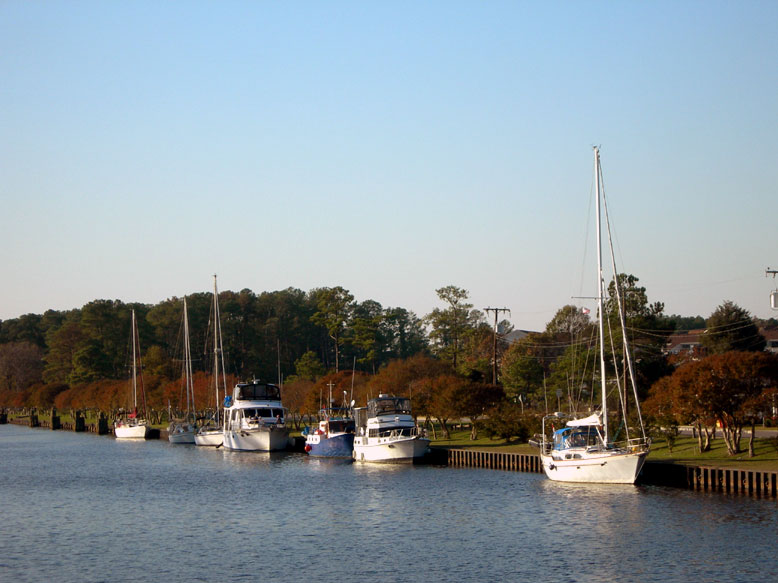
The gateway to the ICW
In the lock at Great Bridge
Our cruising buddies on Con El Viento in the lock
After passing through the lock, we tied up to await the passage of a cold front
Migration of the Snowbirds
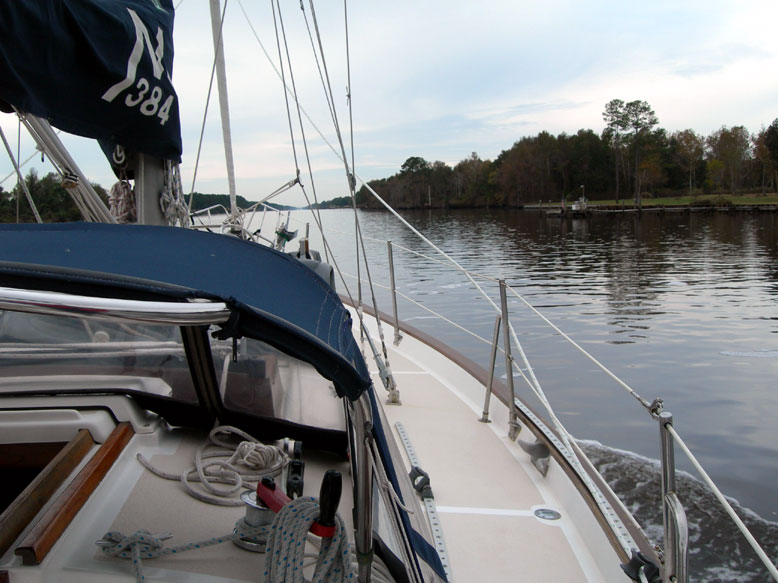
Helmsperson's view of the plotter
Esther and Bruce resort to paddling when their Mercury lets them down (Aligator River anchorage)
Beaufort, NC
Beaufort, NC
In search of wild ponies near Beaufort, NC
The serenity of this scene ended abruptly when a rouge pony chased after Amy
ICW near Bucksport, NC
50 degrees and sunny
50 degrees and cloudy
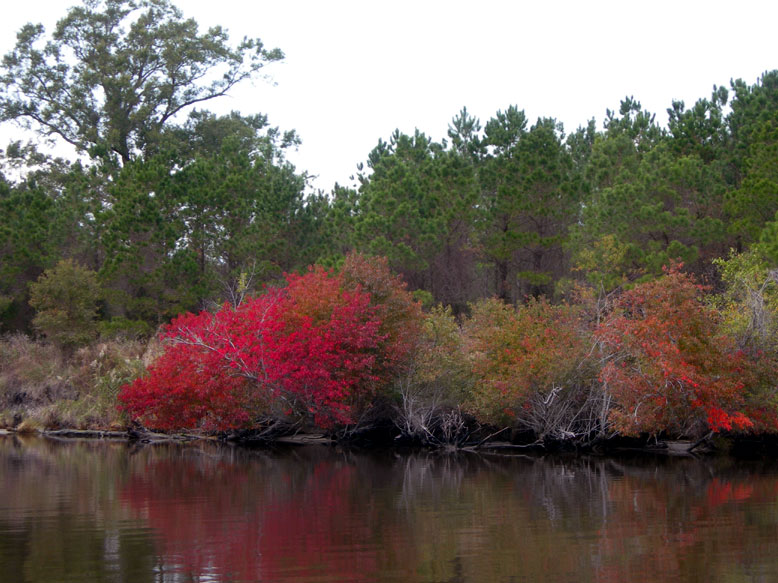
Somewhere along the NC section of the ICW
Ditto
Ditto
Fumbling through the chartbook thinking it all looks the same
The day before Thanksgiving, Charlston, SC
Lunch at Poogan's Porch , Charlston, SC
Thanksgiving Day with Rick and Carla from Euphoria, Charlston, SC
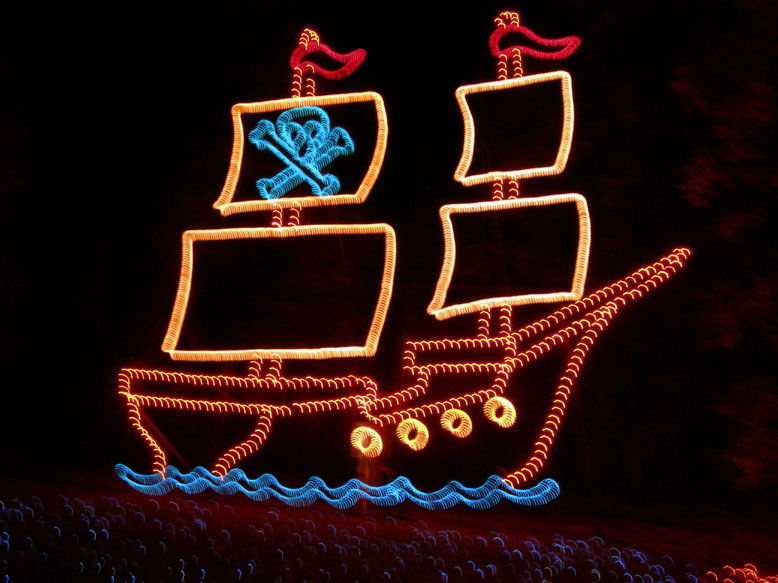
Thanksgiving night, Charlston, SC--the crews of Euphoria and the Mary T went to see the Christmas Lights display on nearby James Island
Ditto
Ditto
At anchor on Steamboat Creek, SC
Out for a walk at Steamboat Creek Landing, SC
Out for a walk at Steamboat Creek Landing, SC
Beaufort, SC
Shore leave in Savannah, GA
Betty Boop in Savannah, GA
Bonbaventure Cemetery in Savannah, GA
Shore leave in Savannah (part 2), GA
Amy and DeeDee in Savannah, GA
Amy and DeeDee after sunset
Bruce, Karen and Jim awaiting the Thunderbolt Parade of Lights
Thunderbolt Parade of Lights (they actually set their boats on fire)
Amy shooting video in St. Augustine, FL
St. Augustine, FL Parade of Lights
Sailing the ICW in Florida
A gull's eye view of Mary T |