 |
Southern Florida and the BahamasPart 2Posted on May 28, 2008 from Little River, SC
Amy and Rose at Rose's Northside Restaurant near Rock Sound, Eleuthera I did finally make a Bahamian friend in Rock Sound named Rose, owner of the Northside Restaurant. One day Kenny and I trudged the two miles from the harbor across the island and up a hill to check out the Northside Restaurant. A white Lab, demanding to be scratched behind the ears, greeted us outside and led us through the bar with sandy floor and into the main dining room. The ambiance was casual with picnic style tables and nautical décor. Set on a cliff, the restaurant commanded an amazing view of the Atlantic. Waves arriving unimpeded from the African coast, pounded the rocky shoreline sending spray hundreds of feet into the air. The place was empty but I found the bathroom, which I badly needed. Exiting the ladies room, I felt a swipe on my right hip. Shrieking I leapt aside and looked back over my shoulder and saw that my assailant was a white cat perched on a stool. Kenny and I took a seat in the dining room and Rose emerged from the kitchen to greet us and we ordered a couple of beers. The cheeky kitty took up residence on my place mat. I was too shocked and amused to be annoyed. It was a slow day, so Rose sat and visited with us. Not only does she own the restaurant, she is the chef and only waitress. A spunky gal in her fifties, she has six children spread all over the world. Rose had just returned from South Africa where one of her daughters had a baby. Unlike most of the women in Eleuthera who were huge, Rose was on the diminutive side. There seemed to be a pretty serious obesity problem on the island. 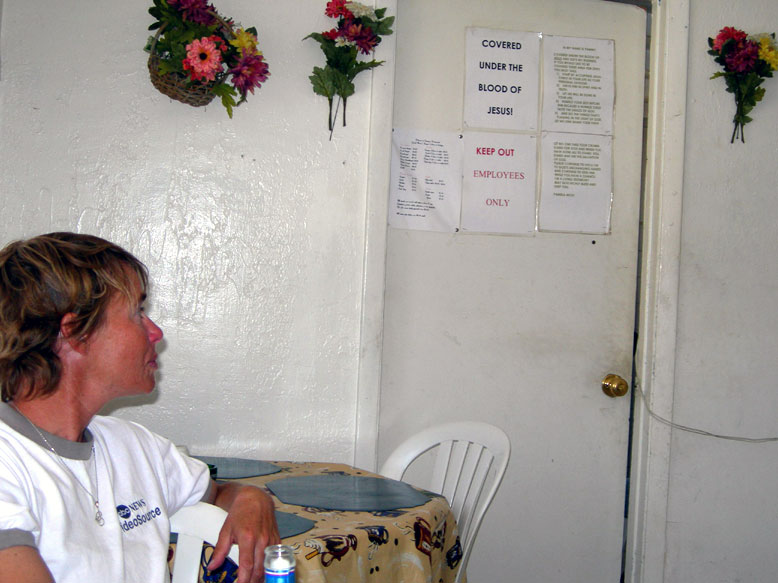
Sign on kitchen door at Pammy's Take-out in Governor's Harbour, Eleuthera 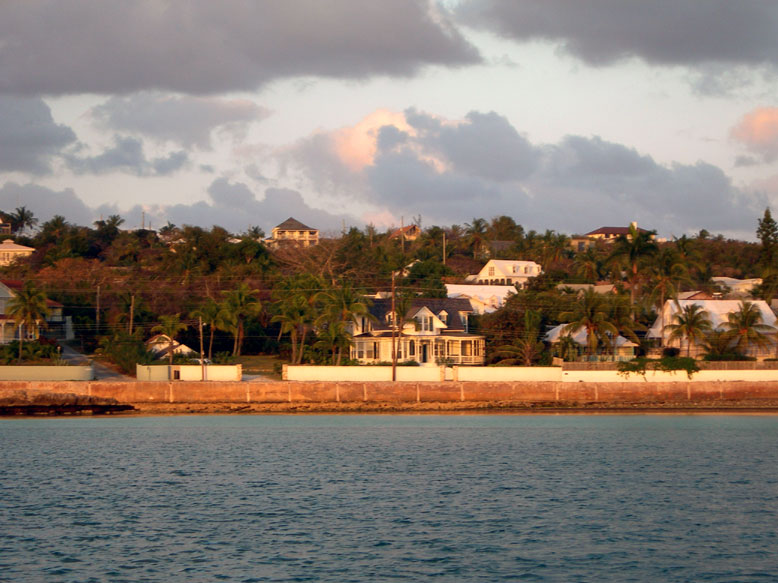
Governor's Harbour at sunset 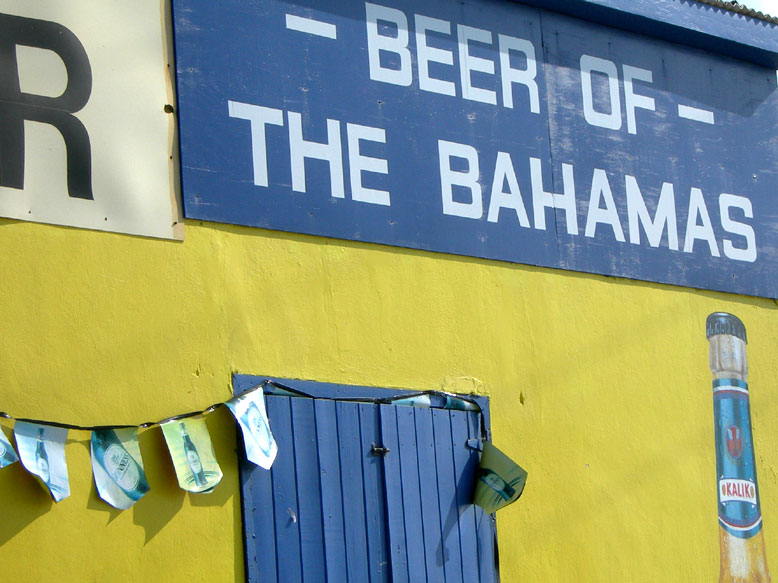
Kalik sign on Pyfroms Liquor Store, Governor's Harbour, Eleuthera 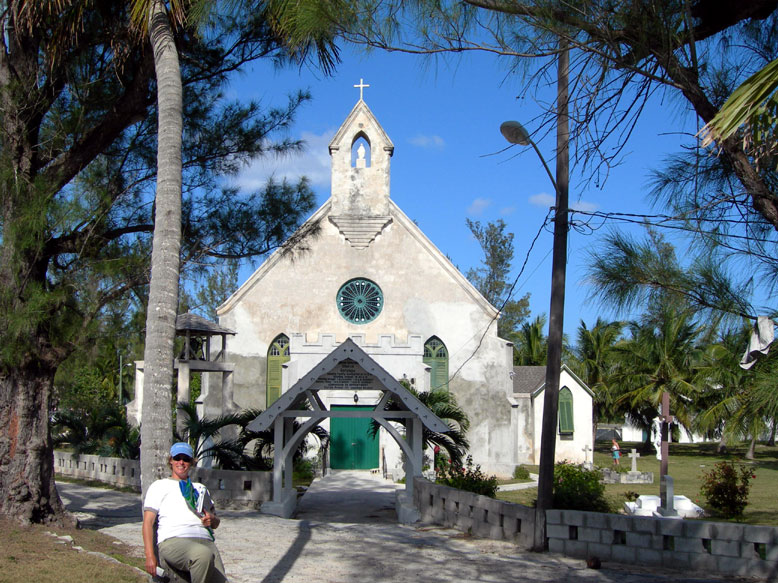
Historic church in Governor's Harbour, Eleuthera 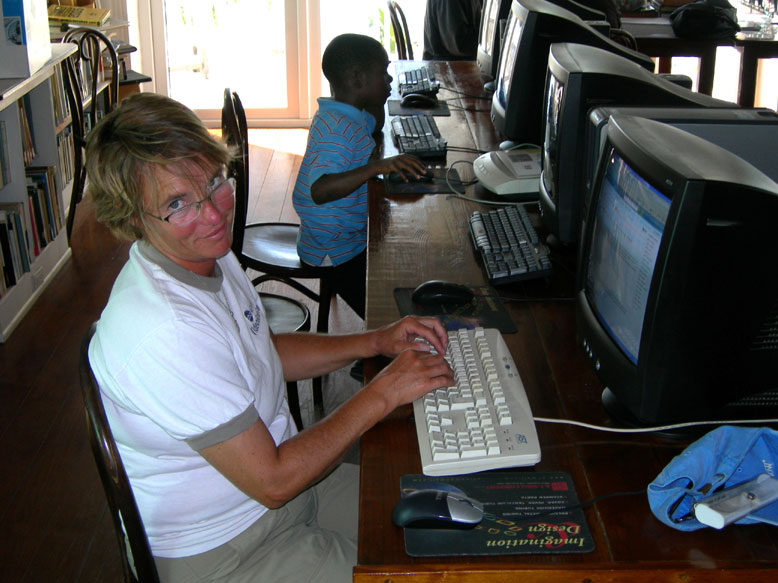
Historic computer in historic library in Governor's Harbour, Eleuthera Another boating couple arrived in the restaurant and joined our conversational bouquet. The man told a story of a diver whose leg was bitten off by a shark. It was one of those dives where bait (i.e. bloody fish) is thrown into the water to attract sharks, and then the divers jump in the water to swim with the sharks. Gee, sounds like fun! Apparently it’s illegal in the USA, but not in the Bahamas. The man telling the story had helped summon a rescue helicopter on the VHF radio, and the victim was evacuated to a hospital in Florida, where he later died. After the other couple left the restaurant, Rose offered to drive us back to the other side of the island where our dinghy was parked. On the way there we dropped off her Haitian housekeeper and children, stopped at the dump to throw out the trash in the back of her van, took her satellite receiver for re-programming, stopped at the grocery store, visited the nearby town of Tarpum Bay to see if they had any fresh fish… all the while we got to know a little bit more about Rose. She grew up in Freeport and was relatively new to Eleuthera. Her husband owned land in Rock Sound, so she decided to build a restaurant on his property. But she was like seaweed to the locals -- something that had just washed up on the beach. She said they would never consider her as one of them. We told her we were interested in renting a car but that Dingle Motors, the only place in town for fuel, laundry, garbage disposal, internet, car rental, marine supplies was all booked up. She said no problem and drove us over to the airport. A fellow named Gregory pulled up in a white Nissan station wagon. “$70 a day.” He held the door open for Kenny. “Uhh, we don’t need it ‘til tomorrow. Can you meet us at the gas station at 10 a.m. tomorrow?” “Sure.” That was it. Rose drove us to our dinghy and we told her we would come dine the following night at the Northside after our tour of Eleuthera in the rental car. The next morning we waited and waited for Gregory to come with the rental car, but he didn’t show. After 11 a.m. I convinced Kenny we should hitchhike to the airport. “Okay.” The same guy who had picked us up the previous day on our way to the Northside Restaurant picked us up again. He was a Batelco employee and on the side of his truck was printed the words: “No Riders.” Didn’t seem to prevent him from picking us up two days in a row. He dropped us off at the airport and we found Gregory. He apologized profusely and explained that he’d been very busy and was about to send one of his fellows to meet us. No matter. He gave us the car without any paperwork, without a deposit, without a credit card number. He didn’t even know our names. We were friends of Rose and that was good enough. It occurred to me later we should’ve gotten his cell phone number in case of emergency. We drove north and checked out the town of Governor’s Harbor, the first site of the British Government in the Bahamas. Nassau is now the capital city. Governor’s Harbor was the prettiest town we’d seen thus far -- lots of large old brightly painted wooden houses that looked like they’d come straight out of New England. The library was a huge airy gorgeous, three-story wood job. After a lovely over-priced lunch on the patio at the Buccaneer, we jumped back in our trusty rental car and headed for the “Glass Window.” The Glass Window refers to a skinny, natural archway connecting the southern three quarters of Eleuthera to the northern portion. If you’re on a boat on the ocean side you can look through the “window” and see the shallow turquoise waters of the banks. The natural rock bridge was worn away by the pounding surf, so now there is a man-made bridge connecting the two parts of Eleuthera. We drove across it, parked the car and walked over to have a look at the pounding surf. Examining the bridge from the side we noticed a large fissure. Hmmm. Had we known it was in such poor shape we wouldn’t have risked the crossing. We stood and watched as large waves smashed against the rocks below sending huge volumes of spray into the air which then fell in torrents and washed across the road. Great, so not only did we have to drive back across the crumbling bridge, but we had to time it so that we wouldn’t be washed off the road and fall to our deaths on the rocks. 
Atlantic waves crashing under Glass Window Bridge, Eleuthera 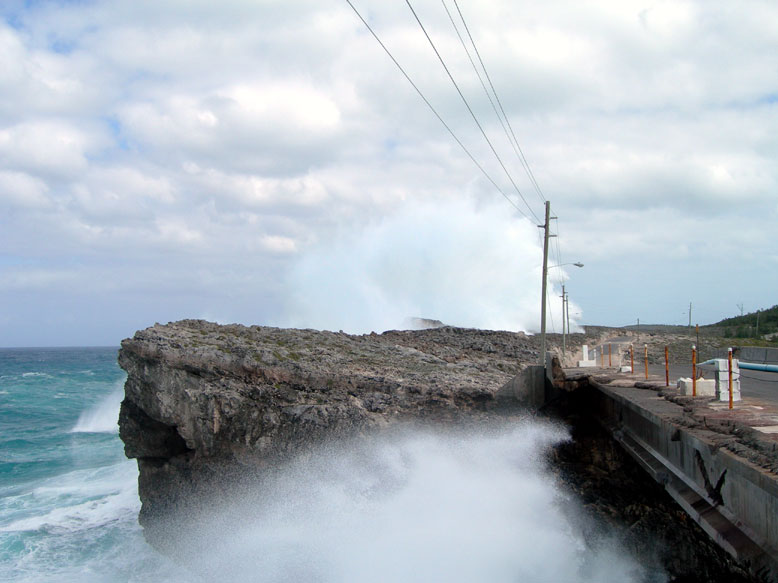
Atlantic waves crashing over Glass Window Bridge, Eleuthera 
Atlantic waves crashing over Amy who was standing not far from the Glass Window The idea of lingering there any longer soon left us. We got in the car and headed slowly back toward the bridge. Suddenly, a big wave sent spray into the air which landed ten yards in front of our car. We stopped until the rushing water cleared the road. Then we knew we had some time before the next big wave, so we made a run for it across the bridge. We survived to tell the tale. I would recommend to anyone wishing to see the “Glass Window” to drive within one hundred yards of the bridge, park the car on the side of the road and walk the rest of the way, paying close attention to the nature of the surf. That night we drove back to the Northside to see Rose again and enjoy a dinner. In addition to us, there was a group of 12 sitting at a long table. Rose was doing all the cooking and serving all by herself. After the others left, we sat at the bar with her to watch CNN and enjoy one more glass of wine. Rose is a big Barak Obama fan and was closely following the primaries. She couldn’t understand what the big deal about race was. Like who cares? She thought it was very unfair that Obama was being taken to task for some remarks made by the minister at his church. She said she didn’t always agree with the minister at her church, but she still kept going. We had every intention of paying Rose another visit, because we really enjoyed her company, but alas, we left Eleuthera without ever getting back to the Northside. After waiting out the passage of yet another cold front with lots of rain and even some thunder and lightening, we headed north for Spanish Wells. We made one stop along the way at Governor’s Harbor. We enjoyed it even more the second time. Arriving somewhere by boat is so much more satisfying than arriving by car or plane. I cannot explain why, but I suppose it has something to do with the time and effort it takes to get there. That day the banks were choppier than usual and it was a rougher sail than we anticipated. Fortunately, it was only about a six-hour trip. On March 27 we landed in Spanish Wells, an island at the north end of Eleuthera with a completely unique culture. It is very Christian and dry. Unlike most of the islands, which survive on tourism and the hospitality industry, the primary source of income in Spanish Wells is lobster fishing. The natives are white. I mean really white, with blond hair and blue eyes and no suntans. Actually some of the men were tan from working outside, but the women were as white as sheets. This was very apparent while having my hair cut at Classy Cuts, a local salon. The contrast of the stylist’s ivory white hands next to my bronzed face was striking. Even the accent of the people in Spanish Wells was different from the other islands. To my ear, it sounded more British and less Jamaican. The old men were impossible to understand and most of them seemed permanently grumpy 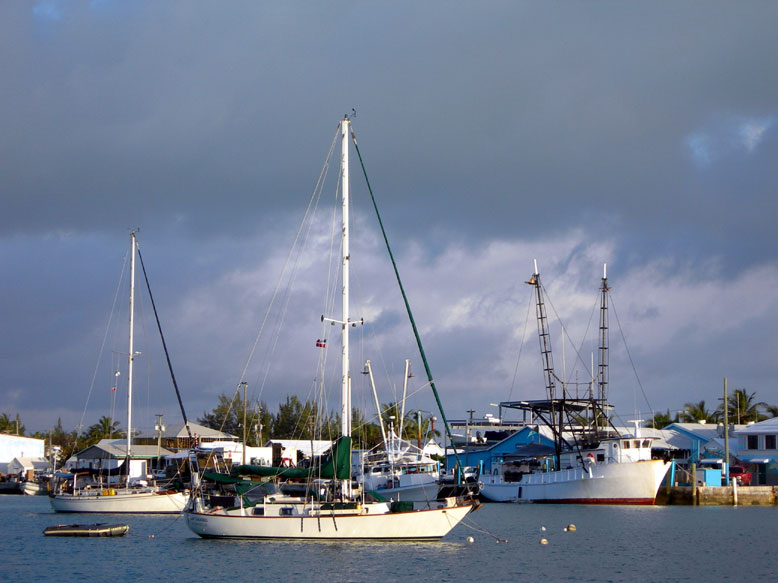
Sunrise in Spanish Wells The island was clean and the houses quite large and brightly painted with immaculate lawns. Some gardens were elaborately landscaped with bright flowers, exotic trees, and numerous statuettes of lighthouses, animals, and gnomes. Primary mode of transportation: golf cart. It seemed that all of the black Bahamians or Haitians working on the island disappeared at sundown back to their homes in Eleuthera or the adjacent Russell Island. I heard two explanations for this phenomenon. One was that the Eleutheran Adventurers who settled in Spanish Wells had no slaves, so there were no black natives. But why had none settled there since? The island of Eleuthera was settled by the same people and there were plenty of blacks there. The other explanation was that blacks were simply not welcome. We spent about a week at the marina there waiting out another blow. Poor Kenny went to the clinic one day, because he’d been suffering from a stomach ache for several days. The doctor prescribed two medications for gas. The remedy didn’t work too well and the Captain continued to feel lousy until he called his doctor in the states who suggested Prilosec. The purple pill did the trick, and after three weeks of suffering Kenny was back to his old self. Thank God. Our delightful Quebecois friends on Kerguelen and their buddy boats showed up in Spanish Wells. They invited us to a cookout one night at a park at the end of the island, but we didn’t attend on account of Kenny’s stomach. We had Guy and Lorraine over the following night for cocktails that turned into a dinner party. We never seem to run out of topics of conversation and they are such a lovely couple. We also met two couples on boats from Appleton Wisconsin. Being a Midwesterner myself, and familiar with Appleton on account of my sisters Mary and Leslie having attended college there, we hit it off immediately. Ruth and Barry on Another Adventure had a parrot aboard named Buddy. They had many stories about Buddy’s allegedly large vocabulary, but I never heard him say a word. Anyway, they were good fun and avid conch blowers. They had decided to leave a day before us with the aid of a pilot nicknamed Ole Pot. The fastest way out of Spanish Wells involves sailing between some rocks and reefs known as “The Devil’s Backbone,” and boaters are strongly advised to hire a pilot to guide you out. We had been planning on going out the long and easy way the following day, but after listening to the weather again, we changed our minds at the last minute and asked to join the boats leaving immediately with the pilot. We were three boats following Ole Pot from the marina and a fourth boat, named Ripple Effect would be joining us at the mooring field. No sooner had we exited the marina than the captain of the first boat in the parade, Aerial, declared he had a problem. We turned around in the narrow channel and headed back to our slips. Ole Pot towed Aerial back. The boat was apparently having a transmission problem. They asked if we could wait awhile to see if they could fix it, but a transmission problem is usually not a quick fix and we imagined the day slipping away. Another Adventure was sticking with Aerial, so we asked if they minded if we took Ole Pot and departed with Ripple Effect. They didn’t seem too thrilled with the idea, but they relented. We tried to communicate with Ole Pot on the VHF as he led us out of the marina, but we couldn’t understand a damn thing he was saying. Next thing we knew, a very large freighter was blocking the channel. Ole Pot went ahead to see if we could slide passed it. Trying to circle in the narrow channel was a little nerve wracking, but we soon got the word that there was room to maneuver around the ship. As we approached the stern of the tanker, he blew his horn to signal his imminent departure. This nearly gave us heart attacks, but we radioed the captain to let him know we were passing his stern and he stayed put until we were clear. At the mooring field, Ripple Effect fell in behind us, and after a few more incomprehensible communiqués with Ole Pot, we were finally in the open ocean, heading for the Abacos. Ole Pot wished us happy sailing and headed back to the marina. We heard later over the radio, that Aerial and Another Adventure’s second attempt to depart was unsuccessful. Aerial’s transmission was still a problem and Ole Pot had to tow them once again back to the dock. They did make it out a couple of days later. The seas that day were rather large (6-8 foot swells) and confused making for an uncomfortable ride. Both of us felt rather ill for the first few hours, but our stomachs eventually adapted to the lumpy seas. With the wind behind us, to keep the jib from flogging we had to sail off course, so we ended up furling the jib and motoring with just the mainsail. We were hesitant to sail the more comfortable, longer route in fear we would arrive after dark. It is no fun entering an unfamiliar harbor to anchor at night. Heading northwest with the waves beating us from the east and the wind from the south, steering was very challenging and we were always ready to turn the helm over to the other at the end of a two-hour watch. In retrospect, we probably had the time to sail the longer, more comfortable route. Oh well… 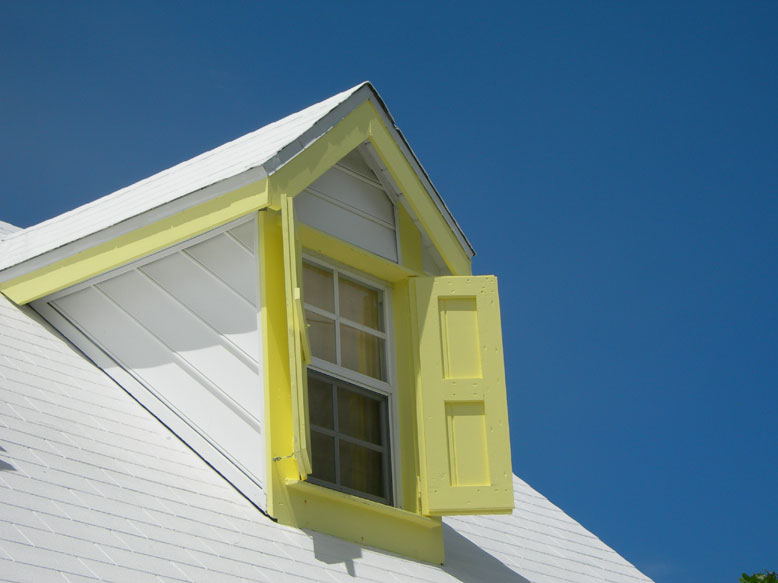
Hopetown, Abaco--where shutters are more than just ornamental embellishments 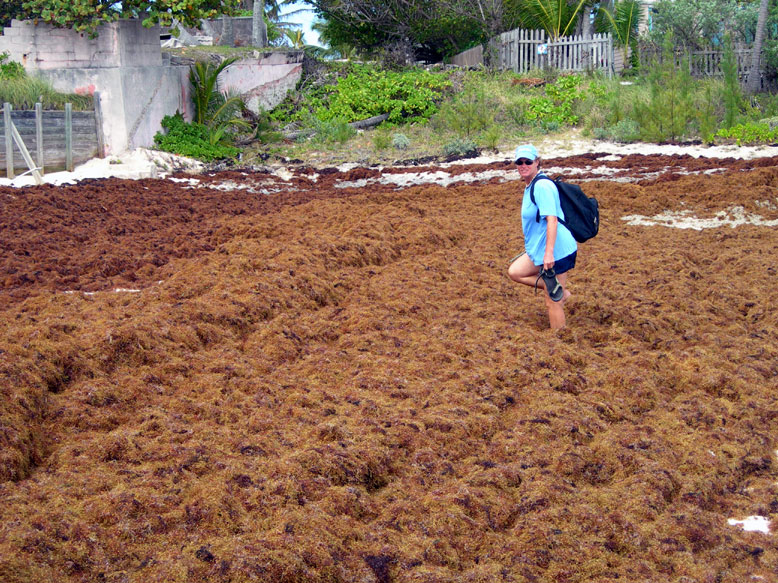
Hopetown, Abaco--where seaweed comes to relax 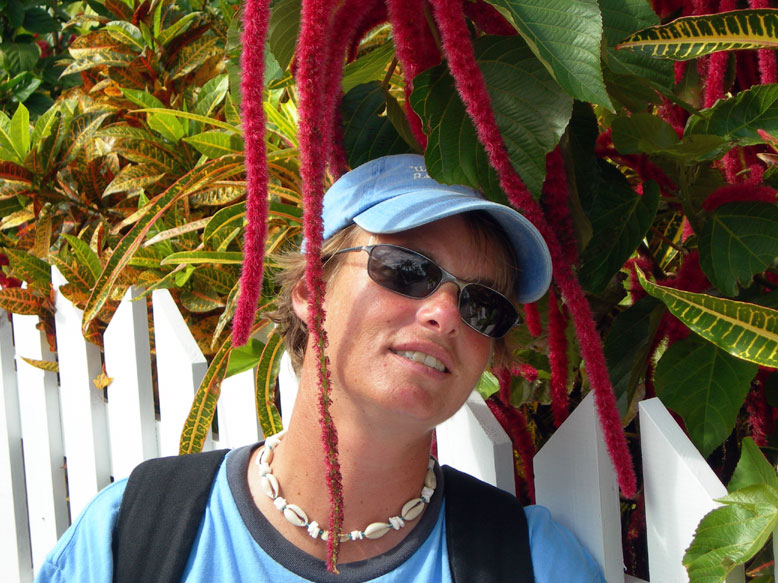
Amy with a rare floral specimen known to botanists as Rastafarius Dreadlockus 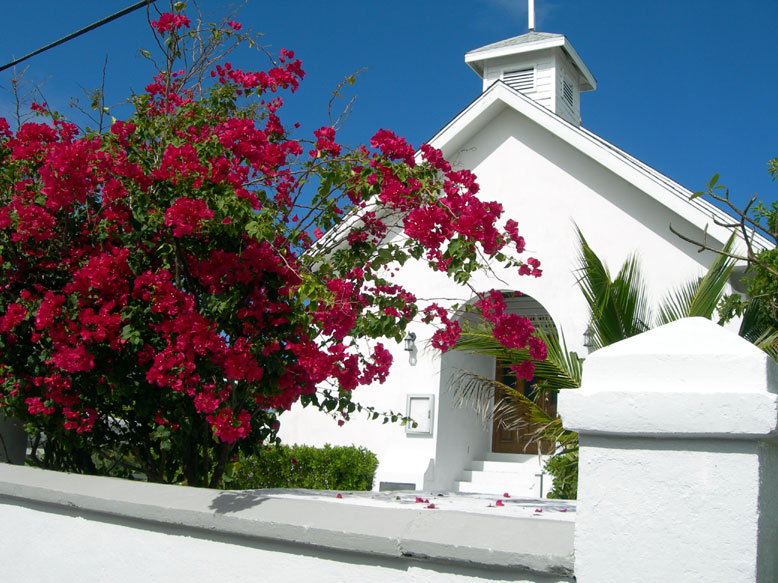
Church on the Beach in Hopetown, Abaco 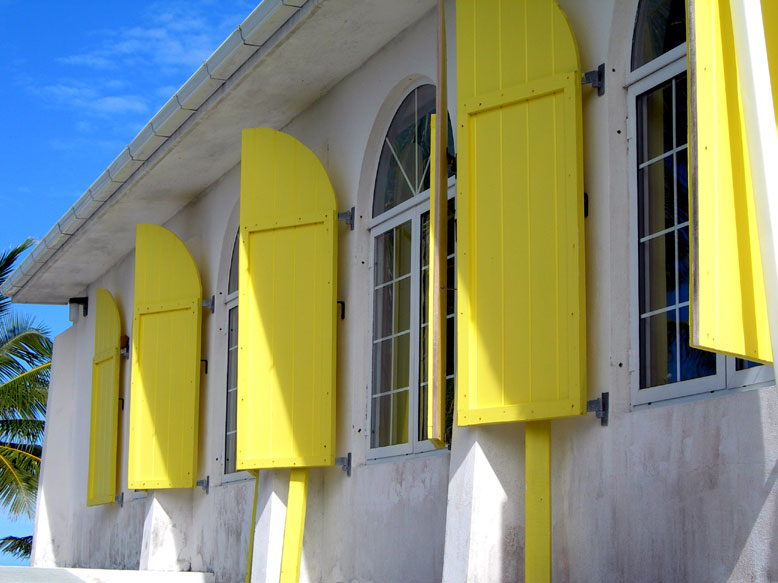
Ditto 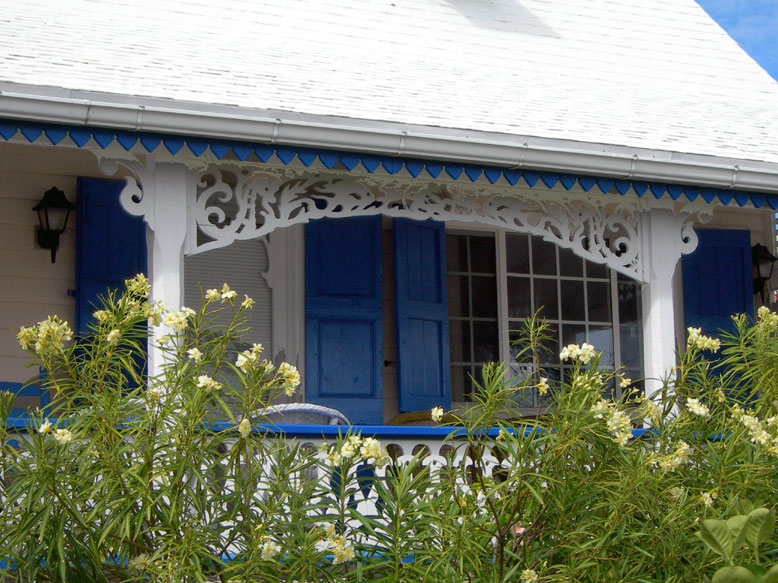
One of many cute-as-a-button cottages in Hopetown, Abaco 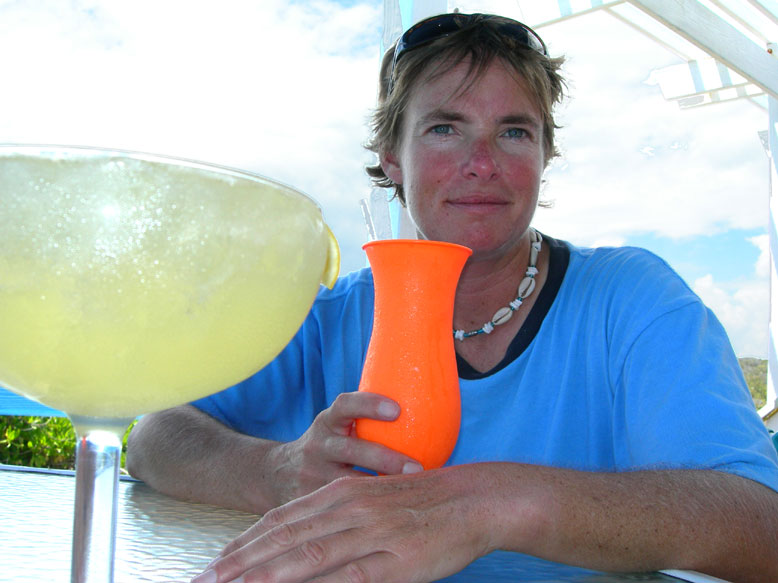
Festive drinks at the 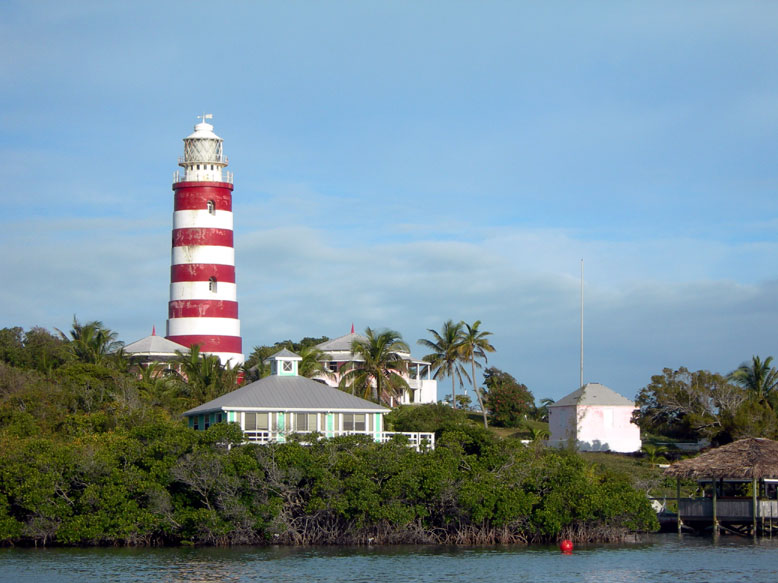
The Elbow Cay Lighthouse, Hopetown, Abaco--one of only three in the world still burning kerosene 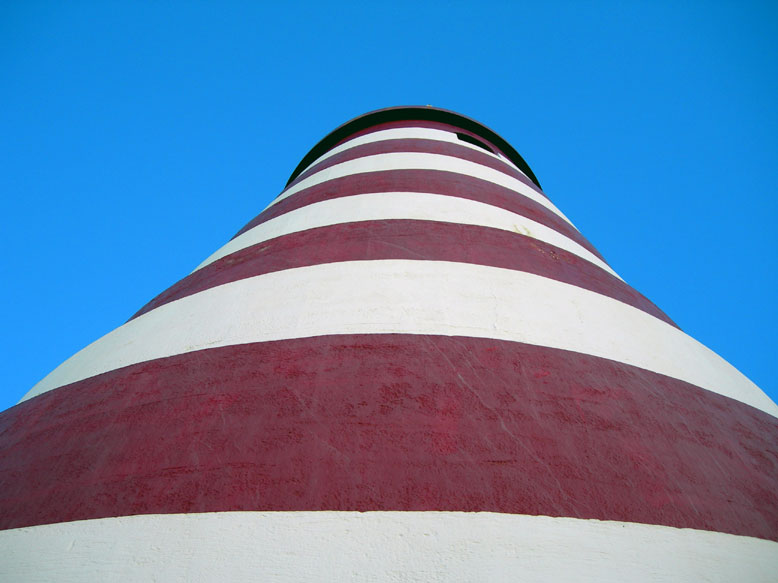
Ditto 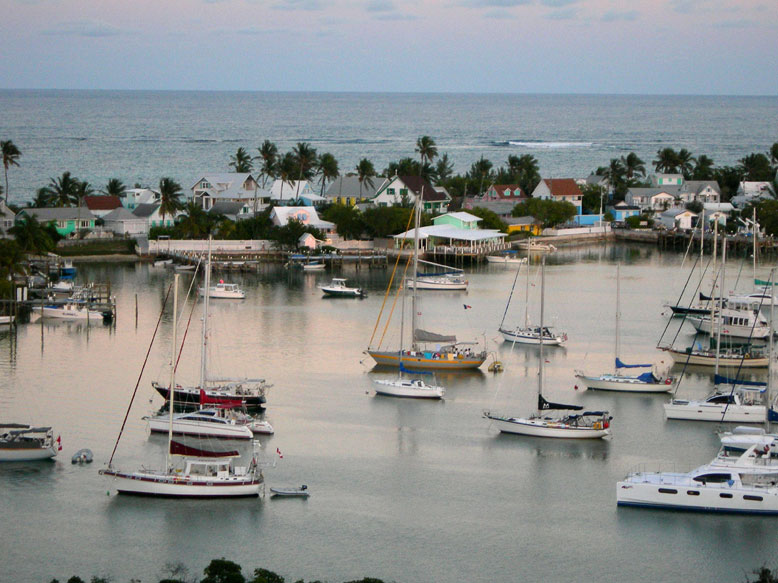
View of Mary T and the Hopetown Harbour from the lighthouse 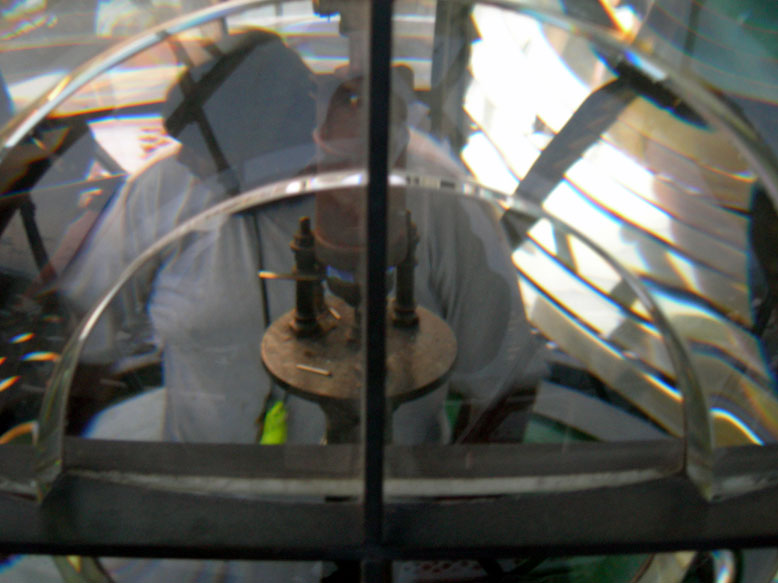
Jeffery, the lighthouse keeper, lighting the light and preparing for his shift Lou and Jane on Ripple Effect, a 35-foot Freedom, had no trouble staying on course without motoring and we were rather jealous. They got way ahead of us, but we stayed in touch via the radio for the entire trip. It was a relief when we finally arrived in the Abacos and entered the bank side of the islands via the North Channel Cut. The wind and tide were with us as we turned west to enter the cut and we surfed into our anchorage with no problem. We spent the next month within the same 20-mile radius sampling the different islands around the sea of Abaco. The Abacos are the most developed of the Bahamian island chains and full of tourists. At times it felt like an extension of Florida. The population is 50-50 black and white and the numbers seem to double during the tourist seasons. Many locals are proud of their American Loyalist Heritage. When the Bahamas gained independence from England in 1973, the Abacos lobbied to remain part of the British Empire. When that bid failed, they sought independence, but that didn’t work either, so they remain part of the Bahamas. Our first stop in the Abacos was Hopetown, Elbow Cay. The harbor was jam packed with boats on moorings and we were lucky to find one available. Anchoring is not permitted as there is not enough space. Hopetown is full of brightly colored houses with beautiful gardens. It is cuter than a button. There is a candy-striped lighthouse, which was built in 1863. Before its construction, many a ship ran aground on the surrounding reef. Locals profited from salvaging the wrecks but also saved many lives. We and visited the light house one night with Guy and Lorraine who caught up to us again, and saw the keeper light it up. It's an old fashioned job that burns kerosene and is hand cranked every 2 hours. Pretty neat. Lou and Jane invited us over for the cocktail hour one night and we had a hilarious time. Like our Quebecois friends, they enjoy talking about things other than their boat and they have sharp, quick wits. Lou and Jane departed the following day for Man o’ War Cay, but we met up again a couple of days later in Marsh Harbor at immigration services. We all needed extensions on our 3-month Bahamian visas because they were about to expire, that is, all except for Jane’s. Hers had expired two and a half months ago. Lou was given the standard three months, and they hadn’t checked Jane’s passport and assumed hers was the same. A recent examination had proved that the immigration officials had mistakenly given her only two weeks. We arrived in Marsh Harbor via the ferry before Lou and Jane arrived from Man o’ War. It was a very long walk from the ferry landing to immigration services, but the whole visa operation took us only 15 minutes. The U.S. Department of Homeland Security could learn a lot about efficiency from these Bahamian bureaucrats. Lou and Jane finally arrived on Ripple Effect and came ashore in their dinghy. We enjoyed a leisurely lunch together at Snappas. Jane recounted an incident about how they offered a local girl on Great Guana Cay a ride in their rented golf cart. Turned out they had a hard time communicating with her and soon realized she was retarded and didn't know where she lived. I don't know how long they drove around with her, because she couldn't tell them where to drop her off. Then Jane told a story about a storekeeper on Man o' War Cay (a dry, very Christian Island) who wanted to give them a Jesus lecture. The man asked if they had time to talk and she said "no" at the same time Lou said "yes." After lunch, Lou and Jane headed off for immigration services, and we assured them the procedure was easy as pie, and added that some Quebecois friends of ours had gone for extensions after their visas expired and had no problem. Well, it didn’t turn out to be so easy for Lou and Jane. Lou got an extension, but Jane was escorted to the airport and sent back to Ft. Lauderdale for a new visa. She later told us that the worst part about the whole ordeal was the way the immigration officials treated her. “What part about, ‘You have to leave immediately,’ don’t you understand?” said the large, fierce woman. Jane stared at her wide-eyed, her mouth hanging open realizing she would have to fly back without so much as a tooth brush or clean undies. Bahamians are pretty laid back, but I guess there's a limit to their patience and generosity. Fortunately, Jane got a reasonably priced flight and inexpensive hotel room and managed to have a perfectly fine time. Kenny and I continued to linger in Hopetown for another week. We wandered around the village photographing the pretty houses and gardens, ate at the restaurants, visited the tiny museum, did a bit of unsuccessful snorkeling, and rode our bikes. On my last bike ride (without Kenny) two spokes broke on my rear wheel, and they weren’t the first to go. It was now impossible to ride. As I was bent over by the side of the road examining the problem, a nice lady stopped her golf cart and offered me a ride back into town. She was an American with a vacation home on the island. It is never hard to get a ride anywhere in the Bahamas. Just stick out your thumb and the first car that comes along will pick you up. Next thing we knew, it was time for the weekly cold front to come through. The wind started blowin' like stink (gusts in the 40 knot range) in the night and we didn't sleep a wink. We stayed in the "saloon" (that's the middle part of the boat) all night with our clothes on in case we had to jump up to avert a disaster. You never know if the mooring will hold or if another boat will break lose and come crashing into you. I wasn't actually too worried, but Capt. Kenny's a professional worrywart, so we kept one eye open all night just in case. Couldn't sleep anyway with the wind howling through the rigging and the boat bouncing all over the place. We finally overcame inertia and left Hopetown. It only took two hours to sail to Marsh Harbor, Great Abaco, the biggest town in all the Abacos. It is devoid of charm but full of conveniences like a large grocery store, liquor store, pharmacies, etc. The harbor is large and can accommodate many boats. Jane and Lou were back there again picking up a friend at the airport, so as soon as we arrived we hopped in the dinghy and headed for Ripple Effect for a last visit before they headed back to the states. 
Amy interviews Jane about her visa problems In no time they had me in stitches. Lou recommended we have some celebratory rum, though it was barely noon. It seemed like a fine idea. Jane served up some sausage, crackers and sliced apple to soak up the alcohol. Lou took a piece of apple then passed the bowl to me exclaiming, “Oh Jane. This is delicious. What do you call it?” We were all getting far too silly, so Jane wisely took the rum and hid it below. Then Ripple Effect sailed over the horizon. Au revoir, funny friends. We stayed in Marsh Harbor, just long enough to do our food shopping and look for a new steaming light bulb. This light is used when motoring at night. We went to several marine and hardware stores, but couldn’t find one. 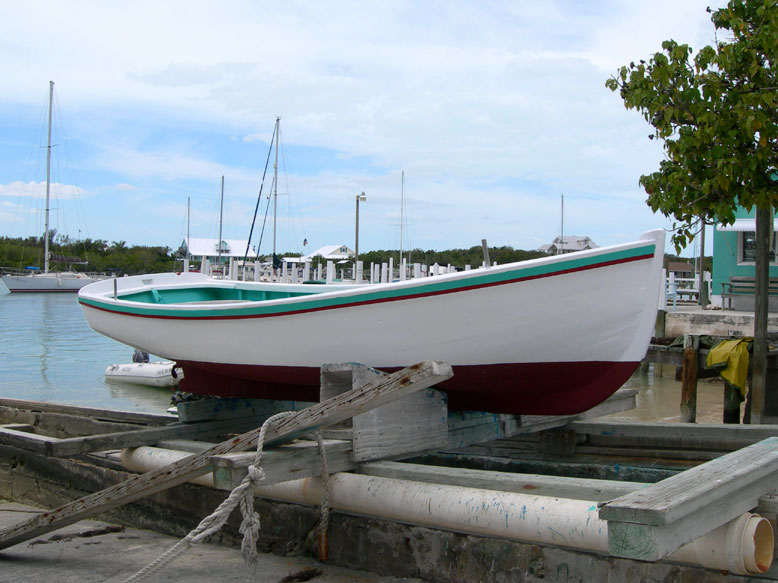
Man o' War Cay is still know for shipbuilding 
The school house on Man o' War Cay The following day, we left Marsh Harbor for Man o’ War Cay. Like Spanish Wells, it is a dry, Christian, predominantly white island known for its boat builders. Many of the people seemed markedly uncheerful. We spent only one day there and managed to cover nearly the entire island on foot. It is less than a mile wide and about four miles long. We came upon a baseball field with bats and balls lying about and decided to have a go at hitting a few. I had not swung a bat since my teens and after missing the first few pitches, I managed to connect and hit several long ones. Then we traded places and I was pitcher and Kenny the batter. Kenny was afraid to swing very hard on account of his bad shoulder, but finally he couldn’t resist and nearly hit one out of the ballpark. Both of us were rather pleased with our performances. Our next stop in the Abacos was Great Guana Cay. There we met up with our old Canadian friends, Karen and Jim on Northern Reach. We last saw them January 2 in Palm Beach. It was quite a surprise, because they hadn’t planned on coming to the Bahamas and were actually heading back to Canada, when they took a detour at Ft. Lauderdale and sailed for the Abacos. They were convinced to go by two other boating couples they had met in a laundromat. Now all three boats were meeting us at Great Guana. It was great to see Karen and Jim again and they recounted their tales of wintering in the Florida Keys with Bruce and Esther on Con El Viento. 
The crews of Mary T, Northern Reach, Irish Rover, and Wind Dust at Nippers There is a beautiful beach on Great Guana, so we did some swimming and snorkeling and hung out at Nippers, a large bar/restaurant overlooking the spectacular beach. Every Sunday there is a pig roast at Nippers with LOUD live music and a buffet of pork, mac and cheese, rice and peas, three-bean salad -- typical Bahamian cuisine. It is quite the scene. We ran into many cruisers there that we’d met in other places. After a couple of days on Great Guana we dropped the anchor at Fowl Cay near the protected reef to do some snorkeling. Karen was feeling slightly uneasy, so I held hand and we headed for the reef. A fish swam right up to us within two feet of us, did an about face and unleashed a huge fish poop right in our faces. Other than that it was just ducky -- beautiful reef with lots of colorful fish. We were happy to find a familiar boat anchored at Fowl Cay called Windfall. It was a couple (Lisa and Raffi) we’d met in December at the marina in Nettles Island, Florida. The cruising world is a small one. We ended up hanging out with them for much of the remainder of the time we were in the Abacos and even back in the States. They regaled us with amusing tales about their charter customers and hosted many a lovely cocktail and dinner party aboard their beautiful 49-foot Hinckley ketch. We parted with Northern Reach and their buddy boats at Fowl Cay as they headed for Hopetown and we returned to Marsh Harbor to do more shopping and hire a diver to install some new zincs on the propeller shaft and keel cooler. We hired a local named Browntip to do the job. In addition to working on boat bottoms, he plays “rake and scrape,” so we stayed an extra day in Marsh Harbor just to see him perform. The group consisted of four guys scraping saws, shaking maracas and singing off key along with CDs. Browntip visited with us during their break and told us how he grew up on a remote out island. To make money he used to collect and sell some kind of plant used to make Compari. He felt lucky to have come so far and have such a successful boat cleaning business. There was an effusive joy about him that was irresistible. 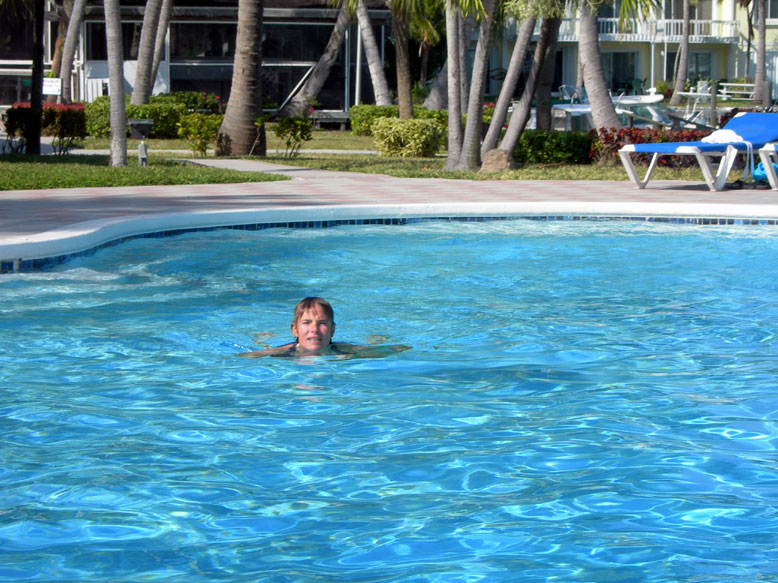
Amy enjoys the pool at Treasure Cay 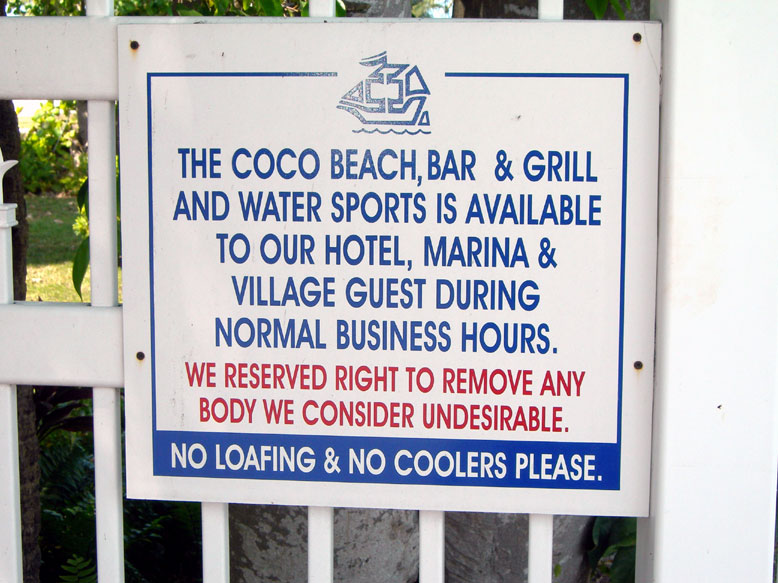
No loafing on the beach? On April 23, we moved on to Treasure Cay, which is really part of the Great Abaco mainland. It is total resort. If you pay $10 a day to anchor there, you can use the facilities including swimming pool and showers. There was a lovely beach and restaurant across the road on the ocean side. Windfall was there and they introduced us to another lovely couple, Frank and Jean, on their trawler Andiamo. Lisa and Raffi invited us all over for the cocktail hour on Windfall. Lisa is an excellent cook and she whipped up some delicious crab fritters for us. A couple nights later, three couples came to Mary T for the party. It was the most people we’d ever had in the cockpit. We had an excellent jam with me on sax and everyone else playing percussion instruments. Two other boaters spontaneously appeared bringing the total to ten. Northern Reach and their two buddy boats Irish Rover and Wind Dust met up with us in Treasure Cay. One night the resort/marina had a pizza party with live music so we all attended. I danced with a four-year-old American kid, an old lady, and (my favorite) a 12-year-old Bahamian boy. It was dark, but he wore his sunglasses the whole time. He was adorable and a really good dancer. Before we departed Treasure Cay, Frank and Jean on Andiamo let us raft up to their boat so Kenny could clean all the growth off the bottom of Mary T. They had one of those “third lung” contraptions, where you breathe compressed air via a long hose. It was Kenny’s first time using it, and he really liked. We would go lots faster without all that grass growing on the bottom. 
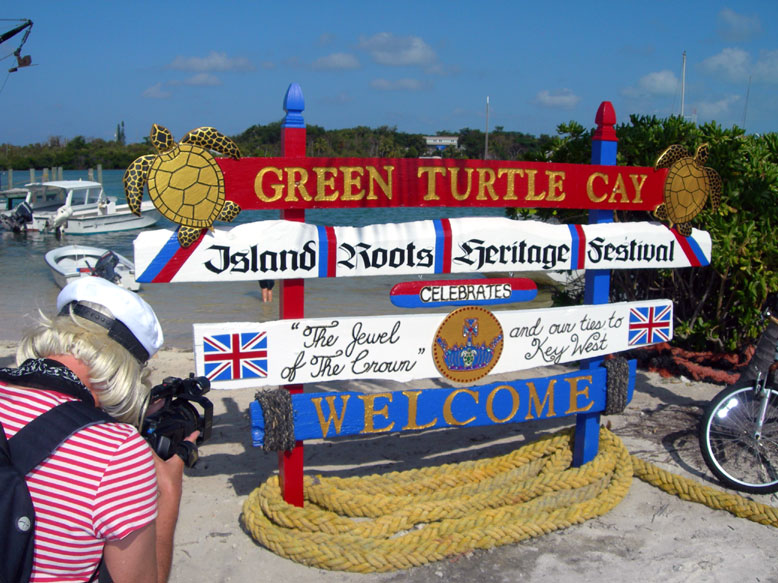
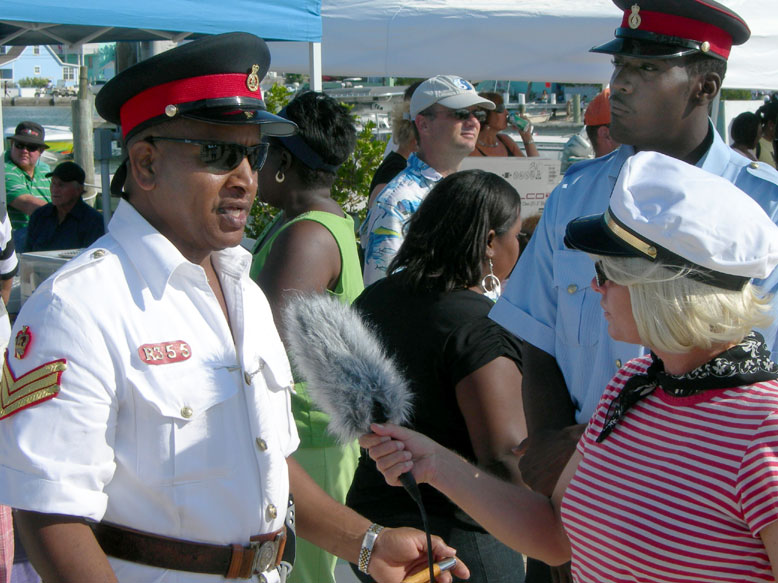
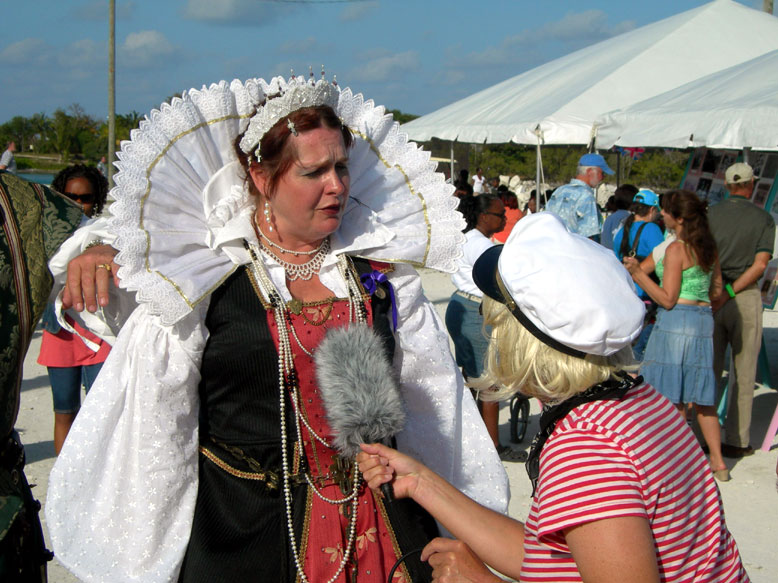
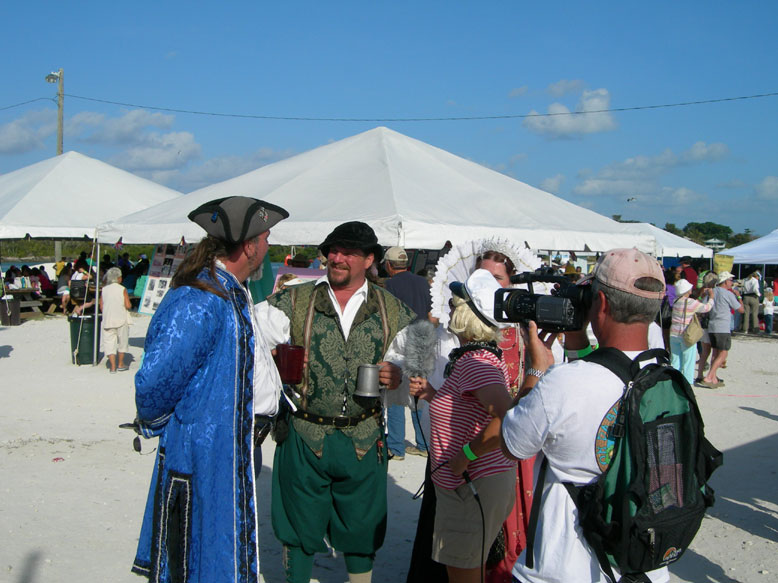
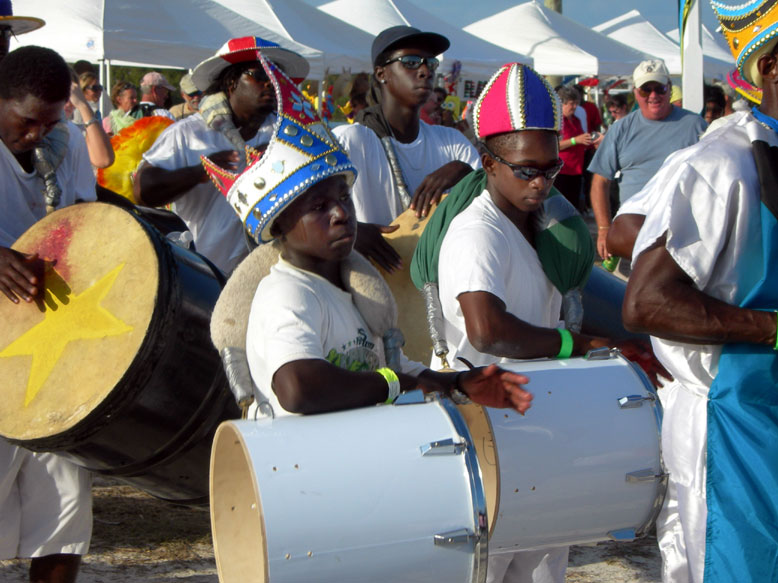
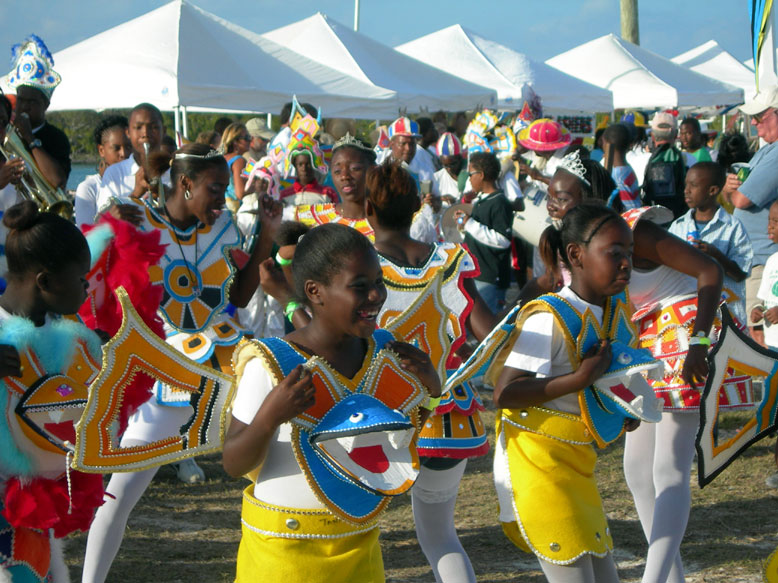
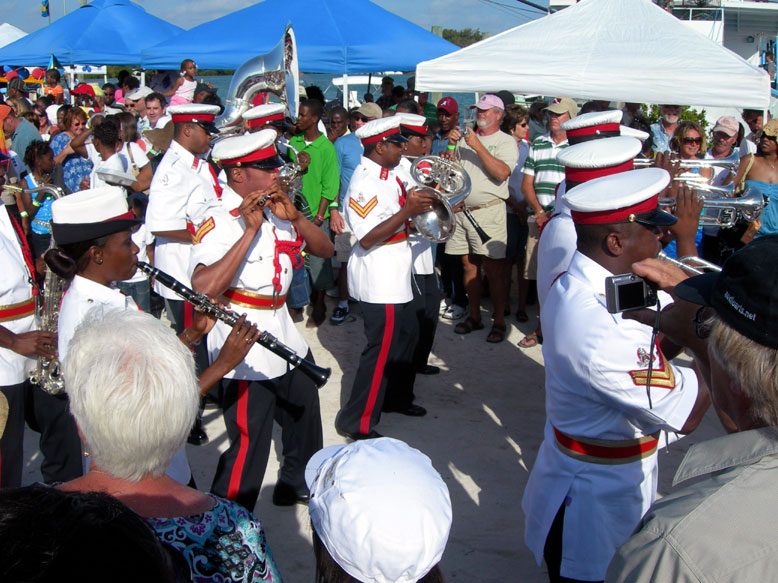
Susie Chatham visits the Mary T Our last stop in the Abacos was Green Turtle Cay. We arrived just in time for their Heritage Festival with the usual food booths, crafts, junkanoo, LOUD music and actors dressed as pirates, Queen Victoria and King George III. There was even a fire dancing act that seemed to go on forever. Susie Chatham from the Sailing News covered the whole event. The next day on Green Turtle. Kenny and I rented our first golf cart and drove around Green Turtle to see all the sights. There is only so much sightseeing a person can do – pretty water, nice beach, more foliage… It was time to head home. A weather window was opening, and we intended to squeeze through it. |

|
|
The flotilla for the crossing included: Northern Reach, Wind Dust, Irish Rover, Windfall and Mary T. From Green Turtle Cay we went to deserted Allans-Pensacola Cay. Raffi on Windfall had given us a steaming light bulb from his inventory, so Kenny hoisted me up the mast in the boatswain’s chair to replace the old one. Just as I was imagining how terrible it would be to drop the bulb, I fumbled and it dropped to the deck below. Not only did I drop the bulb, but I let go of the fixture that houses the bulb. Fortunately, Kenny caught it. The bulb however, was broken. I felt horrible. Still hanging up in the rigging, I saw Windfall approaching the anchorage. 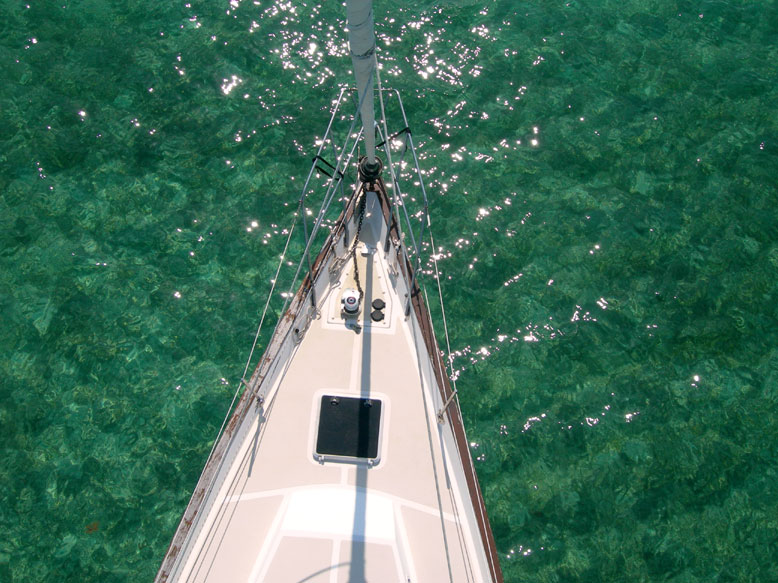
Mary T's foredeck as seen from halfway up the mast 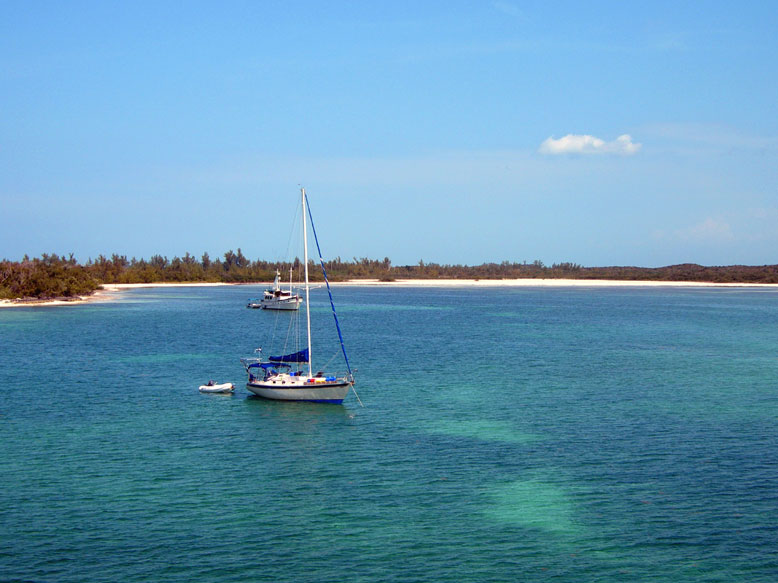
View of the anchorage at Allans-Pensacola Cay “Kenny, didn’t they say they had another one?” Kenny called them on the VHF radio and explained what happened. “No problem,” said Raffi. “We’ve got another one. You can have it.” That couple is one of the most generous and helpful we’ve ever met. That night was Cinco de Mayo and Wind Dust hosted a party with delicious fajitas, quesadillas, and beans. Mmmm good. I brought the salad, of course. The following day we sailed on to Double Breasted Cay. From there we would cross the Little Bahamas Bank, the Straits of Florida, and arrive in Cape Canaveral 24 hours later. Windfall was heading all the way to St. Augustine, but the rest of us would stop at Port Canaveral. Once we got off the banks Windfall raced ahead and was soon out of VHF range. Mary T was a good ways ahead of the other three boats but we kept in touch on the radio. 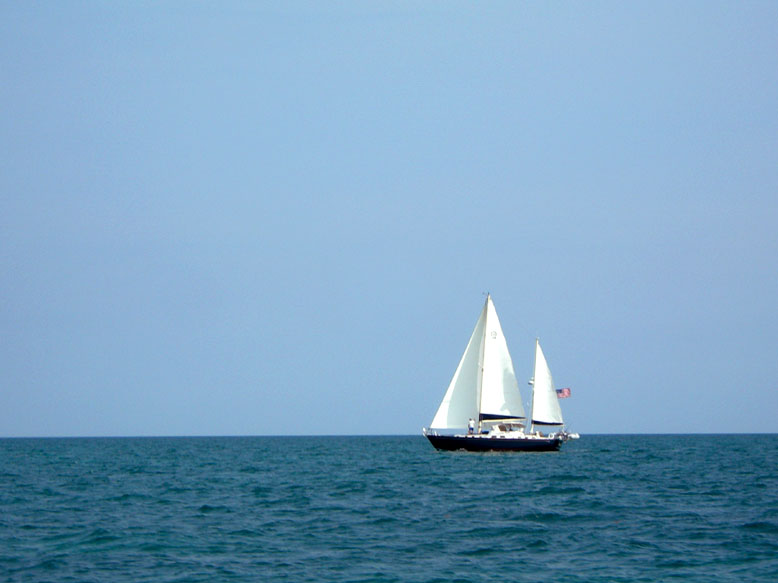
Windfall 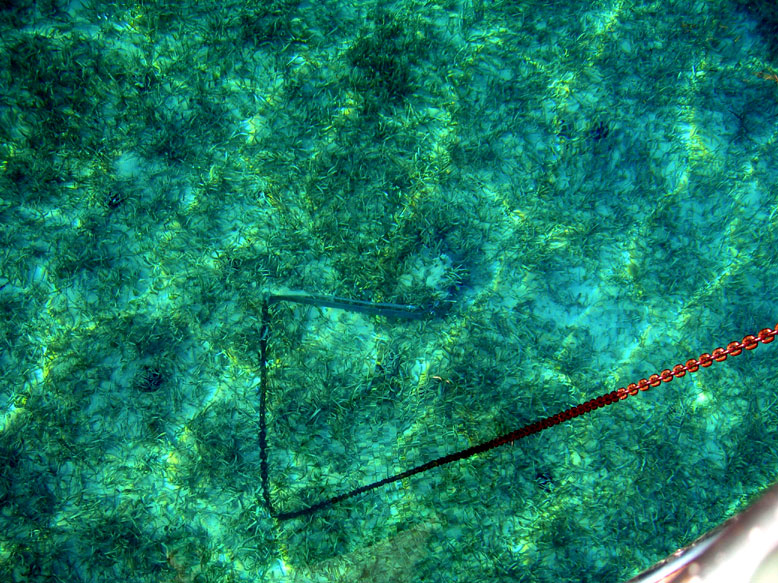
Weighing anchor for the last time in the Bahamas 5/17/08 Actually it’s swell to be back in the homeland. The friendly and efficient service in restaurants and marinas, the low prices in grocery stores and the general friendliness of the population makes me feel good about my country. I am not and have never been patriotic, because the whole concept of nationhood seems rather arbitrary and I certainly had no choice in where I was born. But as a resident of the globe, I rate Americans among the most friendly, open and generous of people. 
Mary T sailing on the Sea
of Abaco The crossing from the Bahamas was annoying, but not horrible. The waves were all higgledy piggledy and the wind not strong enough to plow through them so we bounced to and fro uncomfortably through the night. The whole thing was having an ill effect on me, so Kenny did most of the sailing. I decided to take Sturgeron, a motion sickness pill, which made me sleepy and useless. Well after midnight, fed up with the sound of the relentless motor, Kenny finally turned it off and just sailed. This was also a relief to me as I was able to sleep a little bit. I was later awakened by the mainsail slamming from one side of the boat to the other. Forty miles out of Port Canaveral Mary T was surrounded by cruise ships. Jibing this way and that, Kenny was doing his best to stay out of their way. When I finally managed to pull myself out of bed to relieve him. There was a Carnival Cruise Liner looming over our stern. The captain got on the radio and kindly suggested we go north. We obliged and I took the helm to give poor Kenny a rest. Unfortunately, the pill I took made the compass swim in front of my eyes. After 45 minutes, Kenny took over again. I went below and lay down. The next time I got up, the sun had already risen and the ill effects of the pill were wearing off. Emerging into the cockpit, I found a tired Kenny motor sailing at a rapid clip toward shore. We were going 7.6 knots when I took the helm. I turned off the motor and slowed down, and we sailed beautifully for the last two hours of our journey. Kenny went below and actually slept for a little while. Nuclear submarines plied the waters around the Port Canaveral inlet. When Kenny arose, he called homeland security to declare our arrival. We were told that after docking we should walk to the U.S. customs and border patrol office a mile from the marina. Hmmm? You’d think if they were really interested in protecting the borders, they might come to the marina and see who’s coming in… Immediately after docking, we hooked up with Karen and Jim and headed for customs. The marina gave us a map showing us the way. I was so tired I felt like I was walking through water. We had not been off the boat for more than three days, so everything was a little wambly. The route to customs took us along a highway, past a construction site and through an industrial park of depressing, square aluminum buildings. It was a typical strip of ugly Americana. Surprisingly, there was a sidewalk so we didn’t have to trudge through weeds. I wore the wrong shoes and my left Achilles tendon was chafing, so I took my heel out and smashed down the back part of the left shoe, wearing it like a clog. It felt like a surreal movie. I imagined the customs office would have only one overwrought employee sitting behind an ancient typewriter, a cigarette dangling from his mouth, surrounded by drab green overflowing metal file cabinets. It didn’t turn out exactly that way. When we entered the clean, air conditioned environment, we didn’t spot the customs official at first, but he saw us and grinned. “You just come off a dinghy?” “Is it that obvious?” “Tired, suntanned people in t-shirts. Yeah. Let me get the guy who needs to help you. He’s in a meeting that he’ll gladly be dragged away from.” The man came out and took care of us quickly. He didn’t even ask if we had fruits or vegetables. The only question he asked me was where I was born and I got it wrong. “Libertyville, Illinois. No. I mean Lake Forest, Illinois.” He didn’t care. Then he gave Kenny and me a card which, allows us to sail back into the country without having to go to report to customs in person. We just have to call in. We headed north up the ICW and were immediately held up by a bridge that could not open up for us, because it was waiting for an emergency vehicle to cross. This threw off our timing for the next bridge, which would be closed between 3:30 p.m. and 5:00 p.m. We couldn’t make the 3:30 so we slowed down to time our arrival for the 5:00 p.m. opening. We anchored at Titusville, well short of our destination. The next day was a long one, fraught with stress.
In the early afternoon Kenny and I ran aground approaching Daytona.
Kenny went close to a channel marker on the correct side but
it was too shallow and we got stuck on the bottom. We managed
to motor off the, but thinking he’d made a mistake Wind Dust and Northern Reach offered us assistance but we told them to go ahead to the marina where they planned to fuel up. We’d call Tow Boat US and catch up with them. The Tow Boat US guy arrived in 10 minutes and had us off the bottom in no time. He tied up along side us to do the paperwork as we moved slowly forward. We saw another cruising sailboat coming toward us with a police boat tide up to him. Minutes later we heard Wind Dust say on the VHF that they were being boarded by the police on a toilet check. They pour dye into your toilet and flush it. If the dye comes out in the water, it means your waste is going out too. If that’s the case they can hit you with a hefty fine. Ours was switched to go out, so Kenny ran below to throw the Y valve handle over to the holding tank. Unfortunately, the handle broke off in his hand. So now we were very illegal. We then heard on the radio that the toilet police were over on Northern Reach checking them out. We were sure we were doomed. Kenny and I discussed what to tell them when they boarded Mary T. Miracle of miracles--we were never boarded. We figured we missed out because we had been aground when we were in the first area where they were doing the inspections. Kenny says it was a fortuitous grounding. Anyway, we made it to St. Augustine the following day and Kenny was able to buy a new Y valve and install it. Now we are legal again. Bring on the toilet police. Lisa and Raffi were still there, so shortly after our arrival, we met up with them for brunch at a lovely place across the street from the marina. An old man at a nearby table passed out and fell off his chair. Throughout the brunch I watched the drama unfold. First some people rushed over to help revive him. Eventually he sat up and got back in his chair. The paramedics arrived with all their tools and hooked him up to all kinds of bells and whistles and conducted a million tests. Eventually the man was taken into the ambulance on a stretcher. His traumatized relatives stood by nervously. It was Mother’s day and I imagine he was the husband of the mother being celebrated. Raffi had caught some tuna when they were crossing from the Bahamas, so our second night in St. Augustine, they invited us and Jim and Karen over for a tuna feast. I brought the salad and bread. Raffi even picked us up in his dinghy at the marina, to bring us to Windfall at anchor. That way none of us had to blow up our dinghies. Jim and Karen were similarly generous with us, frequently shuttling us in their dinghy and having us over for dinners. It’s good to have nice friends. The following morning we all headed out of the marina at the crack of dawn. We had a rather disastrous departure. The current was much stronger than we realized and we were having a hell of a time backing out of our narrow slip. Half way out of the slip our starboard bow got pinned against the finger pier and our port beam was wedged up against the piling on the other side. In other words we were stuck. Jim came running over from Northern Reach and pushed our bow out, but unfortunately we hadn’t given Mary T enough gas and as soon as we got out of the slip we found our port beam sideways to the slips and scraping against the anchor attached to the bow of the motorboat in the slip next to ours. My shouts and the noise of boats scraping each other brought out lots of people to help. The owner of the motorboat came out and helped me fend off of his boat anchor while three others on the finger pier held off our bow. Everyone pushed off at once and we gunned the motor. After scraping passed the anchor, hitting a piling and a couple of dinghies with our port stern, we bounced out of the marina. We were both traumatized. As soon as we cleared the marina, I radioed Northern Reach to see if we’d done any damage. Jim said he checked with the other boaters, and no damage was done. We breathed a sigh of relief. I started examining Mary T for wounds and was surprised to find nothing but a couple of minor scrapes. It was a miracle. Praise the Lord. That night in Fernandina we finally relaxed a little. We went out for appetizers and ice cream. The trauma of our morning slowly faded, but we will never again leave a marina without testing the current. The next day, May 14, we bid adieu to Jim and Karen and our friends on Wind Dust. Windfall and Mary T headed out of the St. Mary’s River inlet into the open ocean bound for Charleston, S.C. The wind and tide were opposing each other, so our exit was less than graceful. For about an hour, we climbed mountainous waves and came smashing down on the other side of them. As soon as we turned north and left the shipping channel, the seas worked with us and we enjoyed a perfectly lovely sail all the way to Charleston. We didn’t stop there though, but continued north on the ICW all the way to Georgetown. It was a 34-hour sail. One of our longest days ever. Arriving in Georgetown, SC, we were exhausted. We dropped the hook next to Windfall and backed down on it to make sure it set. It didn’t. We were dragging and needed to haul up the anchor and try again. I stepped on the button to bring it up, but forgot to remove the pin which holds the anchor chain in place forward of the windlass. The pin bent preventing me from using the electric windlass to raise the anchor. I ran back to the helm and took the wheel while Kenny got out a hammer and chisel to try and straighten the pin so we could pull it out and use the electric windlass. It was the fifth time we’d bent one of these stupid pins. I had to put the engine in forward to keep us from bumping into other boats in the anchorage. Out of frustration, Kenny finally pulled up the anchor by hand. Now we were really tired. Rather than trying to anchor again we pulled up to a marina. Fortunately, the slip was on the outside and easy to maneuver into. Thank God. Finally tied up, we breathed a sigh of relief. Cocktails all around. We treated ourselves to dinner that night at a restaurant called the Goat Island Grille. We sat outside on a deck on the waterfront. Twice during our meal a huge possum approached the table hoping for scraps. The first visit startled us, but by the second time we had gained certain affection for him. I think it was his little brown ears that gave him an endearing quality. Nevertheless, we fed him nothing, so as not to encourage his brazen behavior. We alerted our waitress re/ the intruder. She said she knew they had some mice, but maybe it was the possum wreaking havoc in the food storage. Great! Now we’re in a marina in Little River, South Carolina near Myrtle Beach. Tomorrow, I fly to Boston to surprise everyone for sister Molly’s 50th Birthday. Kenny will wait patiently aboard Mary T, reading magazines and immersing himself in boat projects. I’m sure he’ll enjoy the peace and quiet. They don’t call him lone man for nothing. This is probably the last installment of Amy and Kenny’s Great Sailing Adventure Blog. Thanks for reading. We hope you enjoyed it. |
|
|
||